

Mandate of AI
Silicon Valley believes its founders are carrying the future of AI into being. In China, who carries it?

The drive from a batch of AI labs in Haidian district to the robotics company in Yizhuang takes the better part of an hour. We are running half the length of the Fifth Ring, which is ninety-eight kilometers, top to bottom, through a city my Western friends — many of them in Beijing for the first time — keep describing as vast and obscure. The planning is so bad, one of them says.
Beijing has a nickname: West Pyongyang. The city is built not in deference to technological development or civic convenience, but as the visible expression of the highest state organs and their will. Whole districts are closed: residential compounds for Party administration, embassy zones and the housing attached to them, imperial parks left over from the Ming and Qing. On the map, these blocks are gray. You need to move around them.
Stuck in traffic on the Fifth Ring, watching the cars ahead surrender, lane by lane, to a routing the city imposed on them long before they were built — I started to think this was the shape of China’s AI industry. The road runs where the powerful blocks let it run. China’s AI industry is the bloodstream of Chinese innovation and productive force, and it is also confined by vessels not of its own making.
Many of the AI researchers I met in China were focused, with almost monastic intensity, on the technology itself. They did not seem to imagine themselves as their Silicon Valley counterparts often do: as people entrusted not only with pushing the frontier of model capabilities, but also with thinking through the fate of humanity. This is what I call the mandate of AI.
Silicon Valley has taken up this mandate of AI. In China, who bears it?
At the end of April, I went on a nine-day field trip with some thoughtful AI writers, researchers, and podcasters (the trip was organized by SAIL, I was the only person in the group who grew up in China). We visited almost every major Chinese lab in four cities — Beijing, Hangzhou, Shanghai, Shenzhen, in that order. What follows is the reflections of what I saw, organized around the questions that wouldn’t leave me alone.
Two events were looming in the background before our trip began. Chinese regulators had blocked Meta’s $2 billion acquisition of Manus AI (an autonomous-agent startup whose product had gone viral), which had tried to launder its Chinese origins through a Singapore entity. Meanwhile, DeepSeek had released V4, a much-anticipated model whose new $50 billion valuation was striking not only for its size, but for the identity of its lead investor: the China Integrated Circuit Industry Investment Fund. The fund had been created to bankroll the hard substrate of technological sovereignty: chips, wafers, lithography-adjacent equipment, and semiconductor manufacturing capacity. Now, for the first time, it was investing in a large-model company.

The mandate of AI, the social contract
Why don’t Chinese AI researchers think about topics other than technology, such as economics or long-term social risks? Nathan Lambert’s answer was probably that they are humbler, less ego-driven, more willing to do non-flashy work to improve the model — that “far fewer Chinese researchers have sophisticated opinions” about the economics or long-term social risks of the technology, and that fewer still want to. (Florian also wrote about the vibes of the Chinese AI companies).
The observation is very accurate. The framing that ”Chinese engineering temperament“ is the culturally essentialist version of it. I think there is a different dimension underneath, one that has nothing to do with temperament.
In any society, the question of who gets to define the future is settled long before the question of who builds it. In Silicon Valley the answer is that the industry, especially those mega rich AI leaders, defines the future. In China, the answer is that the state defines it, and the AI industry is one of the instruments through which the definition will be carried out.
The AI industry is running fast, but AI as a technology exists here as a subdomain of state goals, eventually to be absorbed into the State’s own vocabulary of Upgrading, Transformation, New Quality Productive Forces — the keywords through which it narrates its industrialized future to itself. Both the AI+ plan (September 2025) and 15th Five Year Plan (March 2026) stated clearly that made AI’s labor impact explicit at the highest level of state planning, and AI shall “accelerating empowerment across all industries”. When the state is the principal subject of that future, the things a Chinese tech company should do, should think about, should not do, and should not think about are settled by this inexplicit social contract.
This social contract suggests the hardest philosophical and economic questions — AI and job replacement, AI and inequality, AI and human meaning — do not belong to those tech companies. They belong to the state and to the academic institutions the state funds and endorses.
You can sense this social contract in how researchers talk about their own work.
The public claims to be building toward AGI are on the record: Liang Wenfeng of DeepSeek, Yang Zhilin of Moonshot AI, Yan Junjie of MiniMax. When we asked those AI researchers in person, what we got back was the same modest sentence, in different mouths: I want AI to replace myself. Robotics founders would say, we want robotics adoption to solve labor shortage. This is the wisdom of what not to say. In front of a group of Westerners who might write down whatever you say, the safest future to envision is your own redundancy and utility that fits the state’s vision.
What the Chinese AGI vision looks like, when it does surface, is its own thing. Zilan Qian has written about the difference. Silicon Valley imagines RSI (recursive self-improvement), a software-driven intelligence explosion, AI building AI in a loop. Chinese thinking converges on something more embodied: human-level intelligence that has to interact with the physical world to mean anything. US and China are running different races, many argue. RSI casts AI as the agent of its own future and the lab that builds it as the steward of that agency. An embodied vision keeps AI an instrument — something that gets deployed, in predicting weather, factories, in hospitals, on roads. Instruments are easier to fold into a state plan.
In Silicon Valley, the consensus is that the future is what the Valley builds, and what market logic makes inevitable. The chosen ones in Silicon Valley believe their companies’ frontier technology will be profoundly disruptive to humanity, yet that kind of “techno-capitalist singularity” still feels unavoidable. There is dissonance, but also an obligation that reads like: “we are entitled to inform the normies that the future may be a paradise or a catastrophe, but either way it will be a future the Valley itself authored.” The combination of a vibrant civil society, absurdly abundant capital, and the certainty that you are the protagonist of history produces a particular kind of ego, and a particular sense of responsibility.
In China, the viable agency to steer the future is the state, and state capacity absorbs AI differently. AI in China is not seen as an elite technology to be contained, nor as an anti-egalitarian threat. It is seen as the state’s instrument of Darwinian upgrade — and the instrument does not get to interpret itself. That work belongs to whoever holds the mandate. The companies build. The state then decides what it has been built for.1
Not a near-peer, not in a race
In Western AI discourse, the US–China AI race is the deepest groove in the record. Silicon Valley figured out a long time ago that selling Washington a race with China was a fast way to get what it wanted. In Washington DC, as YI-Ling Liu has documented, the open secret is that “attach the word China to anything and you can get it done.” Export control is the orthodoxy, the politically safe stance, the topic that gets you the meainstream. China gets viewed through a narrow lens by many in San Francisco and DC: compute, parameters, benchmark scores, open-weight releases, chip stockpiles. In a Western environment where every AI conversation is rapidly politicizing, the US–China AI race is the race.
In China, the AI people simply don’t think about the race at all.
Among Chinese intellectuals, the term “near-peer” has its enthusiasts — IR scholars, mostly, the ones who specialize in great-power competition and who have absorbed the vocabulary as a sign of the new normal. In Chinese AI labs, almost no one believes they are Silicon Valley’s near-peer.
China’s AI achievements over the past year are too many to count, but the industry still depends on Silicon Valley in nearly every dimension that matters.
Many in Chinese tech media and the AI commentariat (AI wordcels) build their readership and their legitimacy by porting and translating Silicon Valley’s discourse for their Chinese audience. Every researcher we met was Claude-pilled, accessing the model through one “transfer station” workaround or another. Almost every Chinese AI lab takes coding capability as a top priority, partly because the ChatGPT–Claude coding race has defined what counts as the frontier.
Then DeepSeek V4 dropped, and the splash that didn’t come told you something. I read that the release had been delayed by the migration of its training framework from Nvidia to Huawei Ascend. It arrived with a million-token context window, improved coding, and a hybrid attention mechanism — features that would have been the conversation a year earlier. On the ground, no one was comparing it to Anthropic’s Mythos or GPT-5.5. People online were discussing the 245-page Claude Mythos Preview system card and trying to work out how advanced the thing they couldn’t have actually was. Epoch’s rough estimate is that the United States is about seven months ahead of China; the actual gap may be widening.
When AI capabilities keep advancing, the soft power is the taxonomic power, and it sits in Silicon Valley. Anthropic gives us “Constitutional AI.” Karpathy named “vibe coding.” Mollick called the unevenness “jaggedness.” In the endless work of naming reality, Chinese researchers are still patiently taking notes.
You could read the asymmetry off other surfaces too. Almost every lab we visited was, in some quiet way, flattered that we had come, and most of them showed us the screenshots — Elon Musk, Peter Steinberger, Jensen Huang saying something nice about a Chinese model. Those companies were all working hard on their English presence on X. When the conversation turned to compute, what came through was the insatiable appetite for Nvidia. I asked one founder whether they used Huawei at all. Purchasing Huawei is required, he said. But we don’t use Huawei chips.
The inferiority complex still runs strong. The things that are actually China’s strengths — abundant electricity, a society and a state aligned in their optimism about AI, a deep talent pipeline — went almost entirely unmentioned. “The best talents are still running away from China,” one founder told me. The strengths below the waterline don’t show up in the room because they are not what the room is measured against.
Spend too long inside the US–China AI race narrative and you forget how deep the human network actually is. The two AI worlds are bound together by the people who do the work. Some of the most endearing moments of the trip came when Chinese open-source researchers and their American counterparts — Nathan and Florian in our group — recognized each other across the table as people who actually do this work.
The Unitree moment
I had written about China’s orchestrated optimism toward AI and robotics — the Spring Festival Gala where the Unitree humanoids performed kung fu and parkour and a nunchuck routine that ricocheted through Western AI Twitter within hours. My fascination with the spectacle had lasted only a few days; my sapiens brain absorbs and normalizes its miracles fast.

By the time we got to Hangzhou I was not particularly excited about visiting Unitree anymore. I had seen the humanoids on television. We had been to two robotics companies in Beijing the week before, and at one of them I had watched a Galbot machine pulling over-the-counter drugs off pharmacy shelves. I went into the headquarters in a what else is out there mood.
At every other AI company we had been led to a conference room and held there through a long, ritualized Q&A. At Unitree we were brought directly into the side hall of the demonstration space — the same room where Friedrich Merz, the German Chancellor, had stood weeks earlier. Inside, quadrupedal robots in different shapes were crouched on the floor, low and patient. A large stage stood at the far end of the room, and on it stood several H1 humanoids dressed in ancient Chinese robes. Closer to us was a single G1 — silver, about 130 centimeters tall, 35 kilograms — already in motion, dancing toward us through a sequence: 1980s disco, then ballet, then a strange self-referential routine in which the G1 pretended to be a clumsy robot, the kind of stiff, jerking machine our older science fiction taught us to expect.
They move just like us, and they are mirroring us. The feeling that came over me was one I had had once before, as a teenager, the first time I held an iPhone. I wrote:
the gesture itself was new, that the whole paradigm of touch had shifted under me, that the click sound was as clean as some cosmic voice.
Standing in front of the G1, I felt that again. What you cannot experience watching Unitree robots dance on a television screen is the sound. A G1 has between 23 and 43 joint motors, depending on the model, and when it dances every one of those motors makes a small, precise cracking sound that the music from its body cannot mask. The cracks are the mechanical effort made audible: joints coordinating, balancing, redistributing thirty-five kilograms across a continuous sequence of complex motion. On television you don’t hear any of this. In the room with the robot, the sound made it surreal.
I have a private threshold for moments like this, and it comes from a film. I grew up on the 1999 movie Bicentennial Man, adapted from the 1992 Asimov–Silverberg novel The Positronic Man. Robin Williams plays a housekeeping robot named Andrew who, over the course of two centuries, replaces his primitive robotic body part by part, like a Ship of Theseus run backward: first facial expressions to match his emotions, then artificial organs to replace the metal, then the capacity to eat and to feel, and at the end the choice to let the biological body age and finally die. The film carries every romantic instinct of late-1990s Hollywood. It also shaped how I understood robotics before I had any other framework.
A child watching that film could absorb, without meaning to, a private rule: a machine that triggers the projection of personhood — the involuntary humanizing reflex our mirror neurons are wired for — has crossed a threshold the others haven’t. Later that night I was talking with a friend who had been on the visit, trying to figure out what we had felt. He said meeting Wang Xingxing, the founder of Unitree, was almost like “meeting Steve Jobs and Jony Ive in 2008. I got very emotional.”
Ken Liu, in a ChinaTalk episode, gave the feeling its name. Human beings, he said, have always “used mythology to express and understand technology,” because “technology is so expressive of human nature… it’s a manifestation of our deepest desires and dreams.” I had walked into the Unitree headquarters expecting another product demo. What I sensed in the room was something closer to awe and mythology.
The mythology is mine, not Wang Xingxing’s. Asked why he builds humanoids, Wang gives the same answer he gives every interviewer: it makes money. The engineers I met at the headquarters had an austerity I recognized — a habit of not making more of yourself than the work requires. As of May 2026, Unitree Robotics has filed for an IPO on the Shanghai Stock Exchange, aiming to raise around $610 million, with plans to list this year. There is about to be a great deal of money in this room. We asked one of the company’s earliest engineers what he was going to buy. He gave a small, restrained smile, and when we joked that he should hurry up and buy a nice car and travel somewhere, he didn’t respond. I think he meant it.
Pull back from Unitree to the wider industry, and what you see resembles where the Chinese EV ecosystem was around 2017: a strategic sector gets officially blessed, and local governments, industrial capital, supply chains, founders, and media narratives all rush in at once. The result, in robotics, is a flood of companies whose names I cannot keep straight. MIIT’s 2023 Guiding Opinions on the Innovative Development of Humanoid Robots was, in effect, the official naming of the lane: the document declares that humanoid robots are likely to become the next disruptive product after computers, smartphones, and electric vehicles. Unlike smartphones or EVs, though, the actual applications for humanoid robots remain narrow.
After the trip ended I flew to Beijing to rest before heading back to the Bay Area. Yesterday, I visited Xiongan New Area — the so-called thousand-year plan, the master-planned city southwest of the capital, designed to absorb Beijing’s surplus functions and become a new center for finance, government, and innovation. The gleaming, curving high-rises stand against an empty sky. Very few live in them. Not a single prominent AI company has moved in.
When the slogan of the mandate drowns out the work of innovation, perhaps this is what gets built, a Xiongan: monumental and unmistakably empty.
Other dynamics & notes:
In the Chinese AI ecosystem, ByteDance is the elephant in the room, except the elephant is also dancing. A cohort of large-model companies we met all operate inside the shadow of ByteDance’s traffic monopoly, and almost every team we sat down with admitted, in some form, that they were scared of Doubao — ByteDance’s model, and the only frontier closed-source lab in China — playing an adoption-first game none of them can match.
Meanwhile, DeepSeek is the most respected company in the room. As Grace Shao has put it, “DeepSeek is increasingly doing the foundation-layer work: architecture, efficiency, inference optimization, and now Huawei-stack adaptation.” Beyond DeepSeek, the community as a whole carries an unusual amount of mutual respect. Competition is real, drama exists, but none of it reaches the court-drama register of Elon and Altman.
Throughout the trip we’d been keeping a private vibe rating of the labs we visited. Some had a high-trust working culture, where researchers spoke with us with easy openness. Some were more guarded — places where face, was an active presence in the room and the conversation stayed careful. One had the unmistakable flavor of state-owned enterprise or a high-status institution: bureaucratic, formal, and somewhat old (?). I will not name which ones. Lily and Kai have written up many more details of the trip; I recommend their accounts for the granular picture.
I wanted to see more cases of AI diffusion and consumer AI. In Shenzhen, what I saw was the parade of AI physical slop, still unbroken. Last year I came across the absurd Midea “DeepSeek Air Conditioner,” an overpriced “AI mirror,” and a wave of AI smart glasses. This year, there was more of it. We walked into a store branding itself as a global hub for “black-tech,” the Chinese internet’s catchall for gadgetry that feels just sci-fi enough to be impressive and just gimmicky enough to entertain. Inside, the inventory ran from anime-style AI figurines to “AI education companions.” The education companions were exactly what you would predict: fluffy dolls with huge round eyes and tiny mouths, cutified into something faintly creepy.
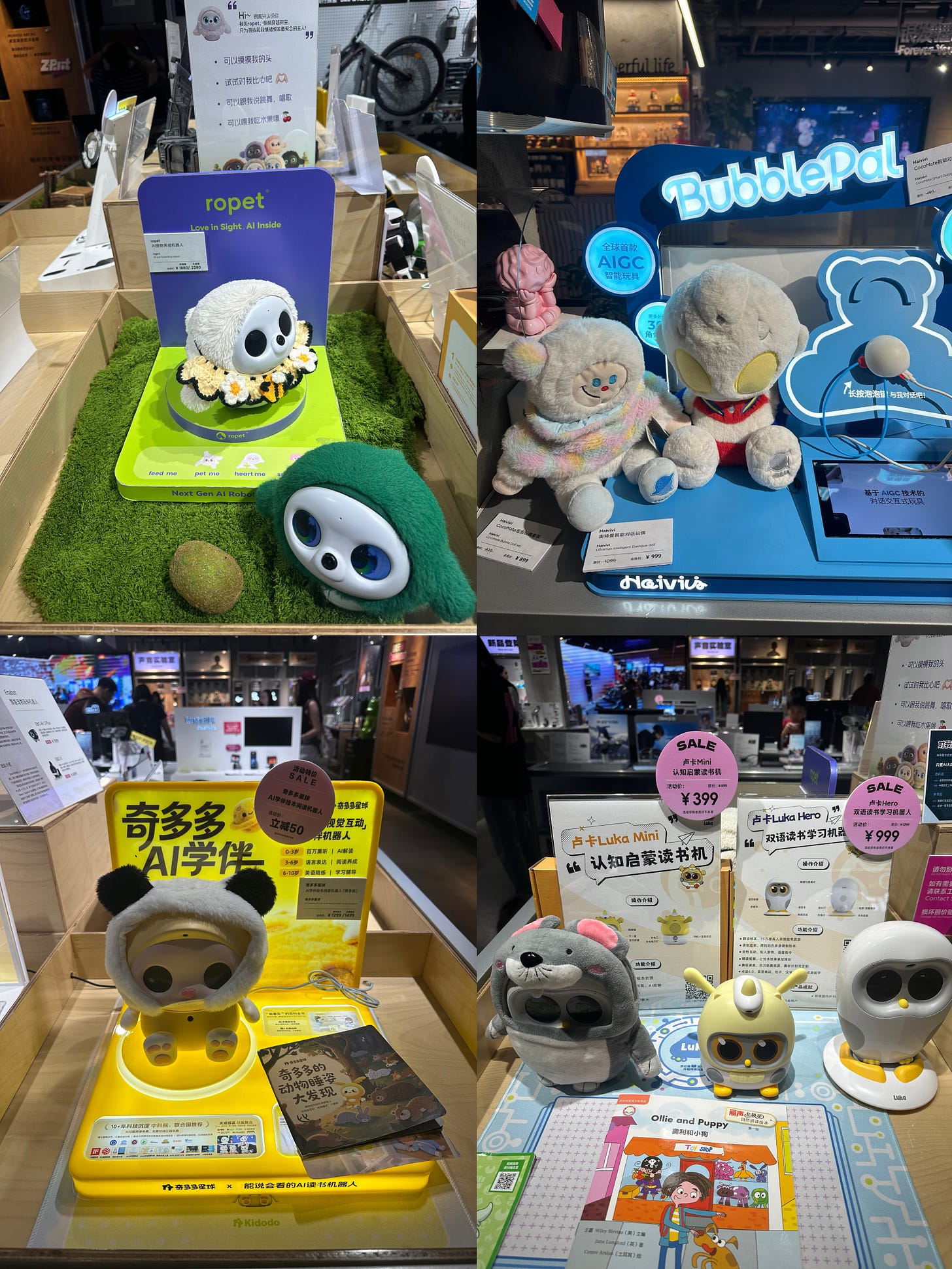
“Big face, small eye, I like, what’s your wechat?” Many thanks to the hero Caithrin for making this trip happen, to Nathan Lambert for enabling it, to Jasmine Sun for coming up with the idea last year (and we ended up doing an epic trip together in China). I am grateful to be part of this; Many thanks to Zilan, Nathan, and Dan for reading the draft and sharing feedback.

Here is inspired by Jasmine Sun’s definition of AI populism. She wrote: I define AI populism as a worldview in which AI is viewed not only as a normal technology but as an elite political project to be resisted.
Great article as always. I was excited to share this with my american friends.
> "Almost every team we sat down with admitted, in some form, that they were scared of Doubao"
0) Truly understated by X(twitter) how bytedance is closest to Google/Alphabet in china. Doubao is actually very pleasant to use better than chatgpt and gemini.
Chinese ecosystem has always leaned more into voice interface and it's maturing well.
1) doubao's frontier model (`doubao-seed-2-0-pro-260215`) isn't even listed on any of benchmark sites like Artificial Analysis, lmarena, etc.
Likely because it's only(?) available through their cloud service ('volcengine') and not available through aggregators like OpenRouter.
But good example of tremendous dichotomy b/w how much china is up to date with developments in usa verses vice versa.
I'd be curious to hear if any of the Chinese companies said (or were allowed to say) anything about the massive negative environmental impacts of their work. Is it currently the same as all the American companies where they either never mention it, or at most, wave their hands away and say that AI will magically solve that too?