

An AI-Maxi New Year
China's Spring Festival was drenched in AI—from Jia Zhangke's short film to robots on the gala stage; Notes from a society embracing the same technology America meets with dread

It’s Chinese New Year, and my timeline is dominated by two names: Jia Zhangke and Unitree.
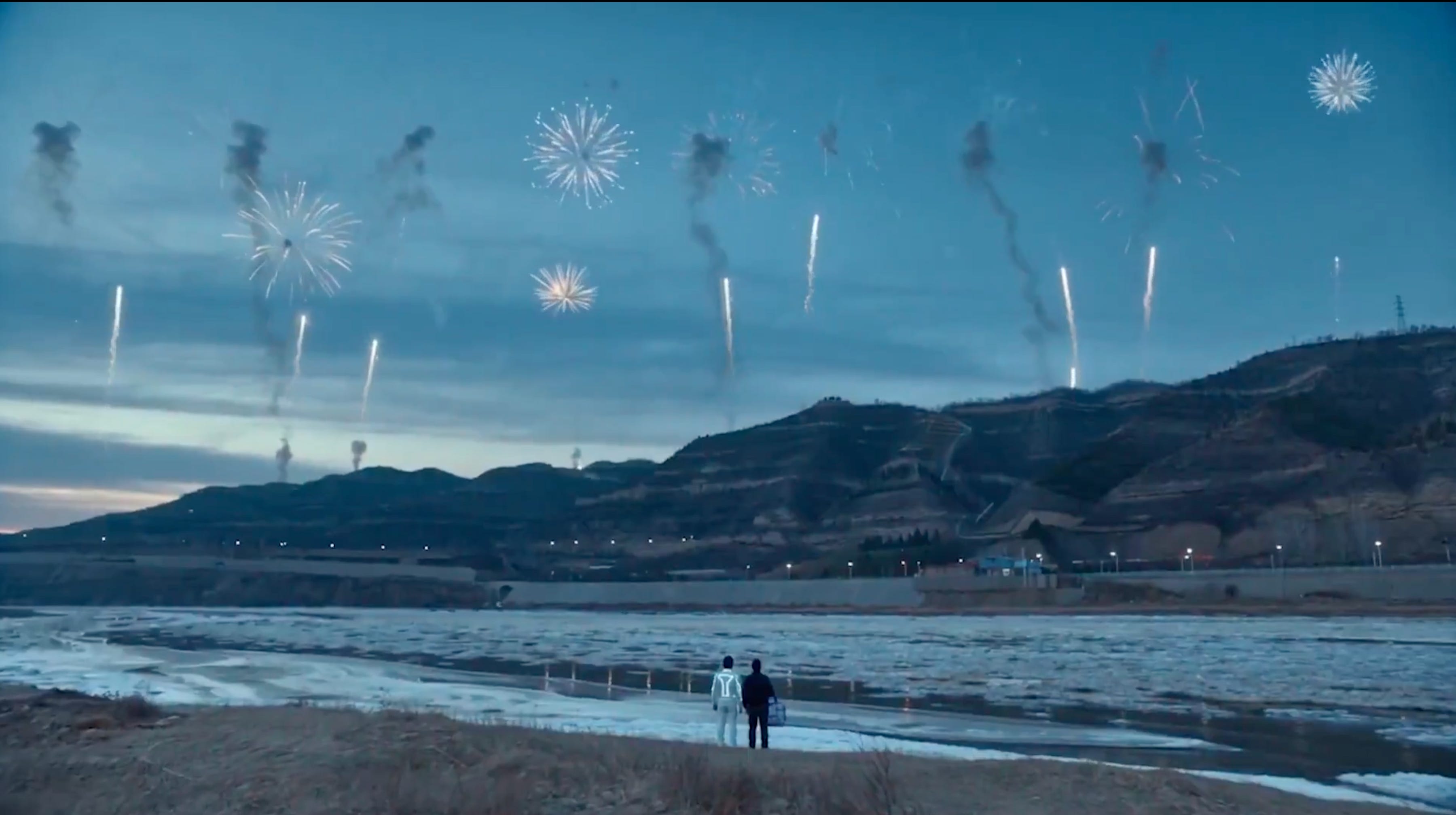
Jia Zhangke, the 55-year-old director whose melancholic, unhurried gaze at ordinary Chinese life has long mesmerized Western cinephiles—turns out to be, of all things, very AI-pilled. This is not an obvious move for a filmmaker whose greatest works are elegies for what Chinese modernization has destroyed.1 But during this holiday, he publicly praised Seedance, ByteDance’s AI video generation tool, and then released a short film made entirely with it. The film is a conversation between two selves: the plain, conservative Jia, thermos flask in hand, and a younger, healthier, optimistic “AI Jia,” debating the nature of filmmaking. In the final scene, the two Jia Zhangkes stand on the shore of the ice-choked Yellow River, a landscape he has returned to across decades of work in Shanxi province, watching fireworks climb into the sky. The palette is his own: subdued long shots, blue-gray hills receding into the distance. The dual selves wish each other a happy new year. The artist has metabolized the technology into something unmistakably his.
The other story is Unitree.
This is the second year the company’s robots have performed at the Spring Festival Gala, an event that functions as something like the Super Bowl fused with a state address, held annually. I consider the Gala an ultimate “mid-curve” aesthetic, a cultural common denominator. This year’s gala was aggressively AI-maxi. The Unitree G1 humanoid robots performed kung fu, parkour, street dance, and weapons routines with nunchucks and staffs—clips that ricocheted through Western AI communities within hours, many joked “we are cooked”. For a robotics company locked in brutal domestic competition, a Gala slot is a coronation. Meanwhile, the gala itself served as a showcase for Seedance at scale: the segment “Blessing of the Flower God” summoned twelve ancient poets, each reciting verse to honor a flower of their birth month, with AI-generated imagery blended near-seamlessly into the live stage. Later I learned that Seedance had contributed backgrounds, transitions, and generated sequences to at least three other performances. The whole production felt less like a variety show than a national stress test of ByteDance’s compute architecture.
When my partner and I were watching the Gala last night, he said it felt too tech-infused—it reminded him of The Jetsons, the 1960s cartoon with its relentless, cheerful obsession with a technological utopia. I think he's underselling it. What I see in China right now is closer to Victorian Britain: a society exuding moral seriousness and deep belief in modernization and technological uplift.
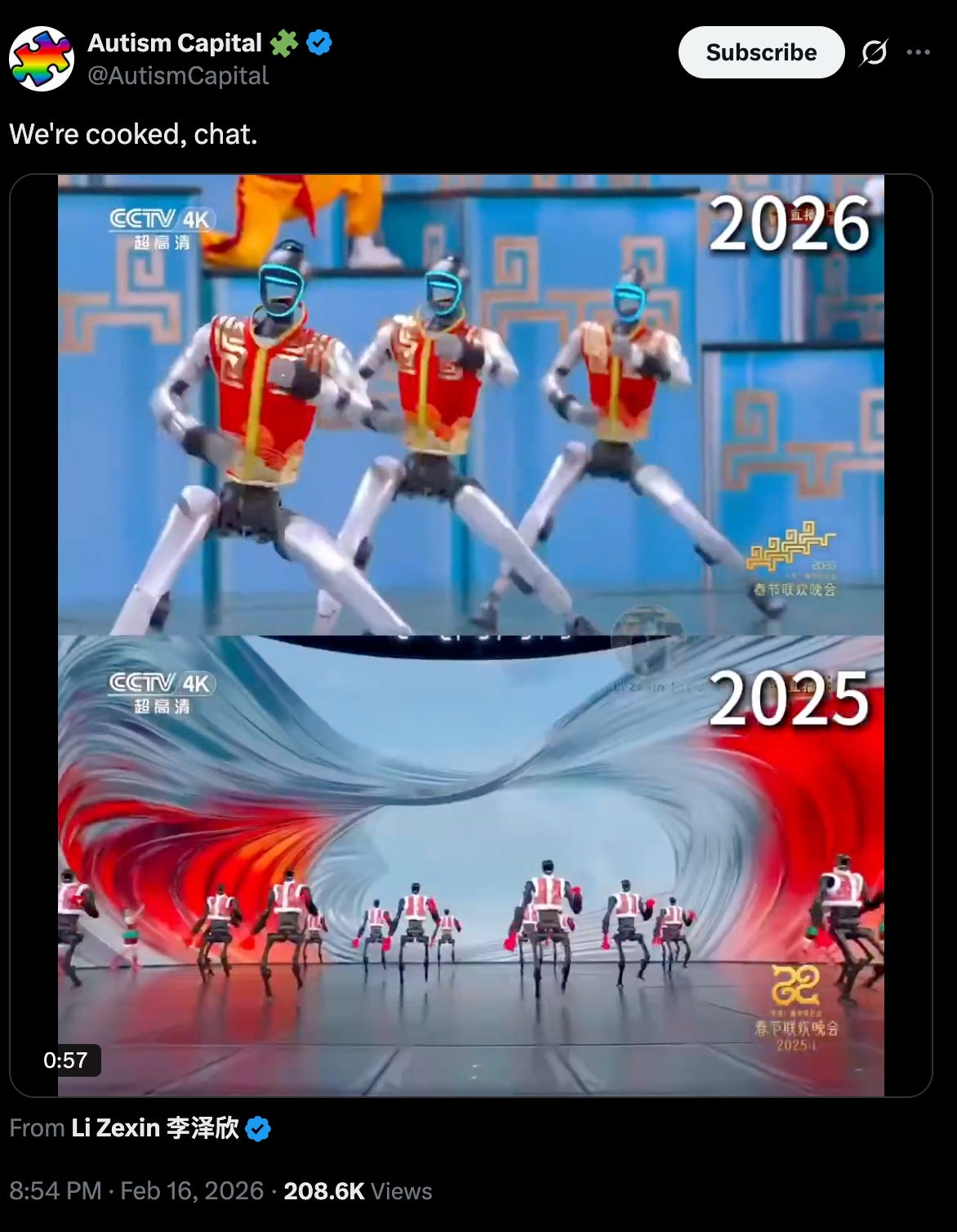
What connects these stories is what they reveal about disposition. The Chinese society, from a world-renowned auteur to the hundreds of millions watching the Gala, is broadly, strikingly optimistic about AI. The reflexive existential dread so pervasive in Western discourse is largely absent.
I remember I spent some time browsing Unitree’s Xiaohongshu account to see how the company addresses the Chinese public, especially about anxiety about job displacement. Turns out, there’s nearly none. The feed is wall-to-wall spectacle: humanoid robots and robot dogs performing in extreme weather, doing impressive gymnastics. The comment sections, meanwhile, are a gathering place for the self-deprecating humor of Chinese internet users. Young people ask: When can I ride the robot dog to buy groceries? When will you release a robot nanny? (Since they aren’t getting married or having children.) And, inevitably: “We need robots for elderly care, it’s urgent, please Boss Wang (means Wang Xingxing, the founder of Unitree) speed up production so the robots can look after us in old age.”
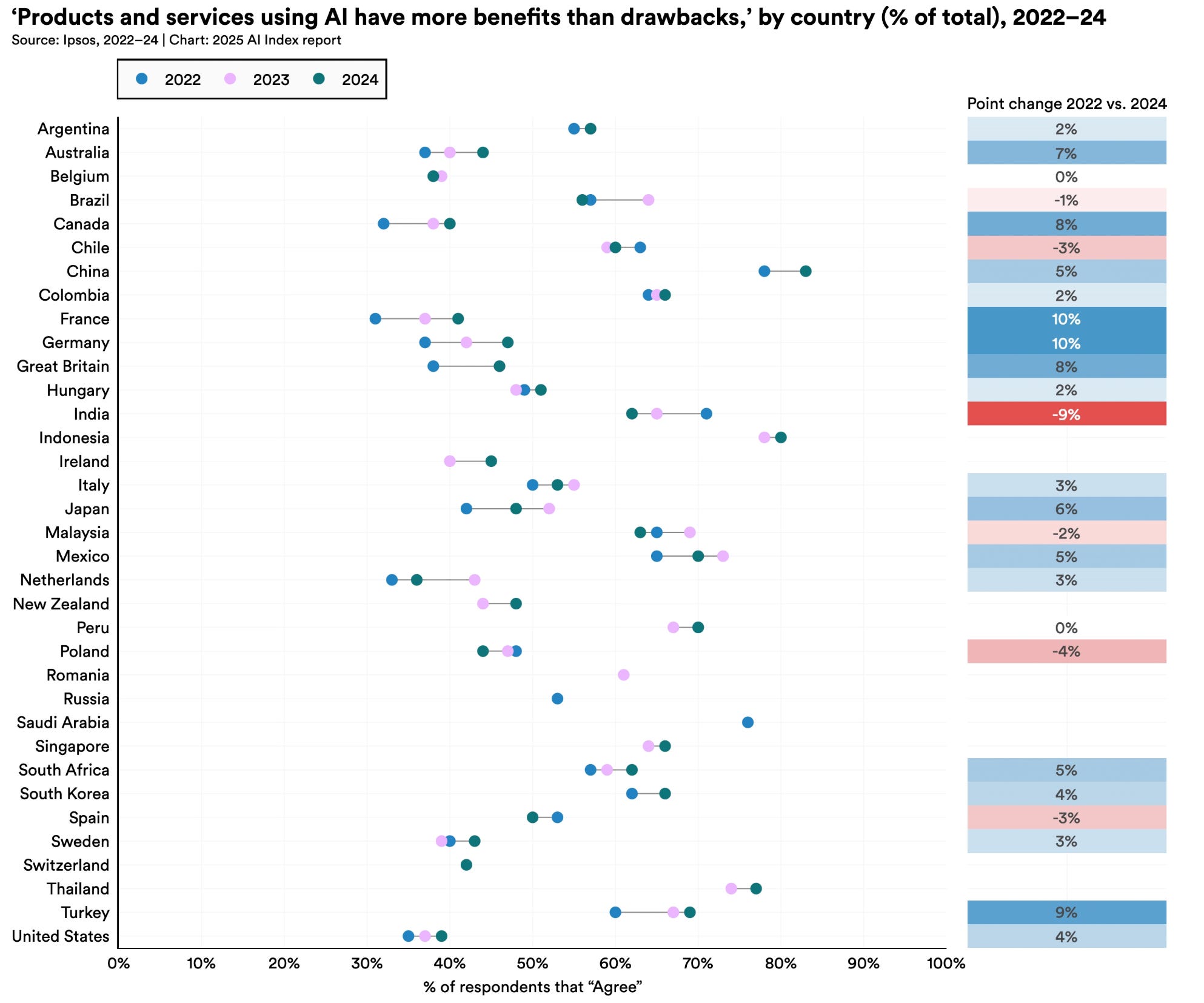
Set this against the posture of Jia Zhangke’s rough American counterparts. On a recent Joe Rogan episode, Ben Affleck and Matt Damon discussed AI filmmaking with open contempt. AI output is “shitty,” Affleck argued, because it regresses to the mean by nature—and when AI becomes ubiquitous, “people will actually value real things made by real people even more.” Meanwhile, the Motion Picture Association has accused Seedance of “unauthorized use of U.S. copyrighted works on a massive scale,” and Disney has alleged that ByteDance effectively packaged a pirated library of its characters into the tool. The resistance is creative, institutional, legal, and corporate—arriving from all directions at once.2
Can we find an American Jia Zhangke? And if one existed, would they survive the anti-AI public siege? Where American AI optimism does exist, it is confined almost entirely to Silicon Valley—the OpenClaw frenzy, the collective Claude Code psychosis, and if you reach back a bit, the 3-year-old “The Techno-Optimist Manifesto,” a self-enclosed declaration that humanity ought to ride the technological trajectory forward, though who “we” are and why we “ought to” remain thoroughly unexamined. What you see is a cultishly bullish tech elite producing manifestos that fail to persuade the rest of the country, set against a China where the public, the government, and the tech industry are broadly synchronized.
Why such different orientations? It would be easy—and cheesy—to credit propaganda alone, as when Palmer Luckey declared that China’s most powerful weapon is “their ability to control people’s minds through the media.” China’s online discourse is heavily constrained, and voices that sound anything like Western liberal humanism or degrowth are unlikely to survive moderation. But this explanation is too thin to hold. Decades of lived experience have taught Chinese society an empirical lesson: technology makes life tangibly better. I once wrote about my Shandong grandmother, now in her eighties, once walked five hours to buy a clock so her children could get to school on time. Today her Xiaomi phone has given her an online shopping addiction, and delivery drones fly above her apartment. For many in China, industrialization compressed and bent time itself—and AI simply looks like the next turn of a wheel that has only ever spun forward.
Technology is also romanticized in Chinese internet culture in ways that have no Western equivalent, at least for today.3 In a recent piece for WIRED, I profiled the “Industrial Party”—a loose online subculture active from the early 2000s through roughly 2018, united by the conviction that productive forces and technology reign supreme, that industrialization’s value transcends political systems and passing cultural fashions. As one self-identified member Fred Gao told me: “These people view industrialization as the highest form of beauty. Building things from nothing—that’s their romanticism.” Within a Marxist framework, too, technology is never primarily a cultural question. AI is the highest form of productive capacity, an industrial upgrading tool, a data governance instrument, a path to technological self-reliance.
In the state narrative of a “century of humiliation,” technology is redemption: the means by which China avoids falling behind, being beaten, being suppressed again. And crucially, China has not experienced the trauma of deindustrialization—the hollowed-out factory towns, the displaced blue-collar workers—that haunts the American Rust Belt and shapes Western ambivalence toward automation. (The layoffs that devastated northeastern China in the 1990s bear an eerie resemblance to that American story, but the wound has been largely buried; only a handful of novels and films from the so-called “Dongbei Renaissance“ still attend to the psychological wreckage.)
In the second week of 2026, I found myself in Liangzhu (良渚), on the outskirts of Hangzhou, talking with AI-native developers and founders. Liangzhu has become, since the pandemic, a default destination for digital nomads and technologists who reject the grind of China’s big tech companies—twenty minutes from Alibaba’s Hangzhou Future Park headquarters but closer in spirit to its inverse. People in Liangzhu don’t 996; they work in coffee shops with their dogs, they build small, beautiful AI applications.
There, I met Xiaokai, a founder born in 2001 with six employees. His company produces AI-generated video, taking on commercial projects from tile advertisements to telecom spots to short dramas sold to streaming sites like Tencent Video. His studio already turns out work ranging from “Love, Death & Robots”–style sci-fi to conventional ads you’d never guess were AI-made.
Before discovering AI video tools, Xiaokai’s biography was a cascade of false starts: a failed actor whose show never cleared censorship review, a livestream company shuttered during the pandemic, a fashion studio abandoned when he realized his taste wasn’t good enough, and—he told me this with disarming frankness—an invitation to enter the gray economy of soft-sexual services. Then he found Way to AGI, a Chinese online community dedicated to self-teaching AI tools, and began learning video generation platforms like Kling (a generative AI tool by Beijing-based Kuaishou) and MiniMax’s Hailuo. “AI completely changed my life,” he said. When I browsed his social media afterward, I found he’d already been profiled by media as “one of China’s first digital directors to truly monetize AIGC”—held up as a case study in what one article called “the AI democratization revolution in the film industry.” In the photos, he was walking red carpets at fancy film festivals in Beijing and Shanghai.
Xiaokai’s story is quite dramatic, but it would be dishonest to frame it as typical. Most young people in China share the same intense cynicism as their American counterparts—about the economy, about mobility, about whether hard work still converts into a better life.
Yet technology still firmly occupies a particular position in the Chinese imagination: it is still seen as a channel for upward mobility in an anti-nihilistic way, one with a more legible, more quantifiable path to success than the alternatives. And because state industrial policy now explicitly favors AI, the pressure to pay attention radiates outward—not just to young developers but to established entrepreneurs from industries with no obvious connection to AI or software.
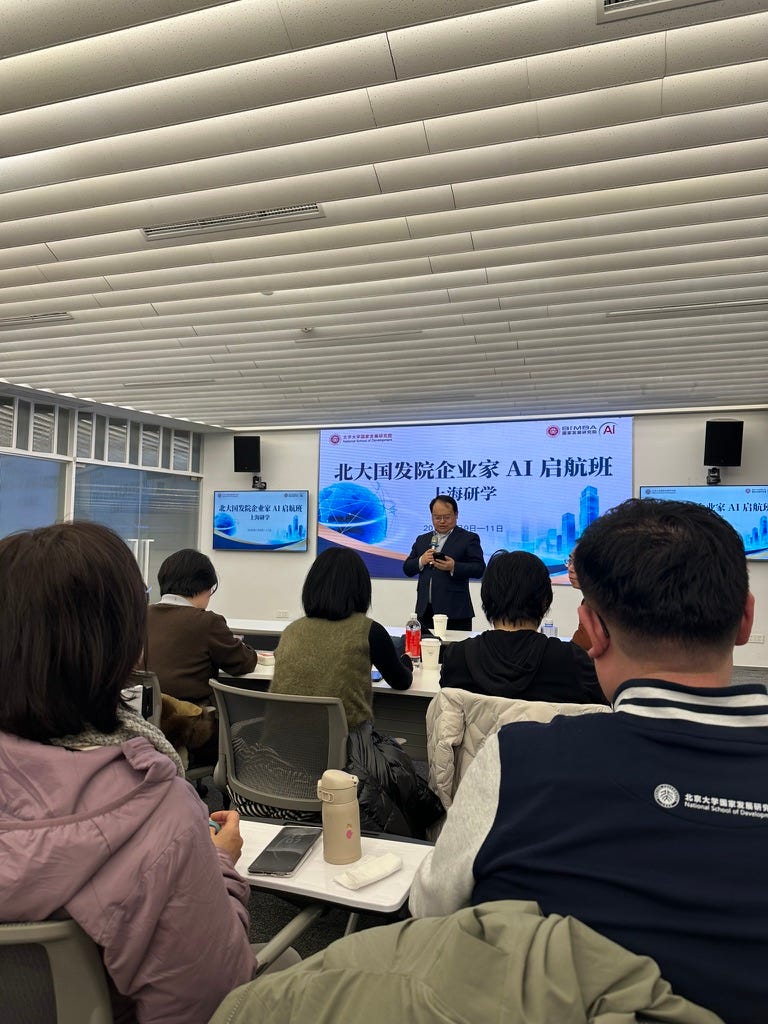
When I was in Shanghai before the trip to Liangzhu, I attended a dinner hosted by Peking University’s National School of Development (北大国发院) for a short-term AI course. The cohort was almost entirely mid-career founders from traditional industries across China: they meet once a week for six weeks, driven by some mixture of vanity—the combination of “Peking University” and “AI” sounds impressive on a business card—and genuine curiosity about where the AI opportunity might lie. Over dinner, I spoke with a man who owns a large electronic generator factory in Wuhan, a man who sells high-end Wuchang rice in Dongbei, and even someone who runs an aquarium. Each of them told me, in different ways, the same story: the internet had already transformed their businesses once, and they didn’t want to miss the next wave. None of them could yet articulate a concrete use for AI in their work. They were there anyway. If I could easily account for the Chinese-style hunger and FOMO around AI, I genuinely couldn’t picture its American equivalent—a dinner where an Iowa corn farmer and an Atlanta aquarium director sit down together for a six-week AI course at Stanford.
Writing this during the first day in the year of the horse, I realize my intention was never really to analyze. It was to record a moment—this New Year, when the texture of a society’s relationship to its own technological future became, briefly, legible. The gulf is enormous: an American society increasingly suspicious of and hostile toward AI, and a Chinese society that embraces it with hunger and FOMO. There divergent trajectories that will certainly produce divergent realities. In ten years, will I be eating AI-optimized Wuchang rice from Dongbei? Will I be watching AI-made blockbusters that have quietly replaced Hollywood? I don’t know. But this New Year, the future was so near, it was on the gala stage, on the frozen Yellow River, on a red carpet for young AIGC directors—arriving unevenly, but arriving.
Notes & recent work
I’ve recently started a short fellowship at GovAI in London, where I’ll be writing about China’s relationship to open source AI. If you have expertise or interest in this area, I’d love to talk. Please reach out!
Beyond GovAI: Kaiser Y Kuo invited me onto the Sinica Podcast to discuss the Industrial Party and the crowd-sourced time-travel novel The Morning Star of Lingao—the deeper story behind my recent WIRED piece. I really enjoyed this conversation.
I also recorded a very fun episode about Chinamaxxing with Jordan Schneider, Lauren Teixeira and Minh Tran on ChinaTalk, and was interviewed for this BBC article written by Koh Ewe.
I’ll be writing more about the AI scene in Liangzhu, there is so much to unpack…
Eugene Wei mentioned to me that some of his best elegies on Chinese modernization are epitomized by Still Life (2006), a movie about the Three Gorges Dam—his favorite symbol of how state-directed progress renders some human lives disposable and some communities displaceable. Jia also championed DV filmmaking before most other filmmakers. Eugene says: I've always found him to be an enthusiast when it comes to new production tech, reflective of the Chinese mentality towards technology more broadly. It's fascinating that he's working with a technology from ByteDance because I most associate him with documenting how technology rewires our interiority—and perhaps nothing out of China has done more of that on a grander scale than TikTok/Douyin.
The resistance to AI in Hollywood extends well beyond the legal threats from the MPA and Disney mentioned above. In 2023, both the Writers Guild of America and SAG-AFTRA launched strikes in which AI protections were a central bargaining issue—the first major labor actions in the entertainment industry to treat artificial intelligence as an existential workplace concern. Around the same time, A24 used AI-generated imagery in a promotional poster for Alex Garland's Civil War and faced immediate backlash on social media, a minor incident that nonetheless signaled how quickly audiences had learned to police AI use in creative industries. Perhaps the most symbolically charged episode was Scarlett Johansson's public confrontation with OpenAI in 2024: after she declined the company's offer to license her voice for its conversational AI, OpenAI released a voice assistant that Johansson said sounded unsettlingly similar to her own, prompting a legal dispute and widespread public sympathy for the actress.
Both Eugene and Zac reminded me that the U.S. had something similar to Industrial Party’s techno-romanticism. Zac mentioned Star Trek fans who spent decades building a deep technological superstructure around a TV show with an extremely weak technological scaffolding—people who wrote papers about hypothetical designs for the Enterprise warp drive. Eugene mentioned the West's romantic infatuations with tech: Stewart Brand, Steve Jobs, 1990s cyber-utopianism, etc.
Stanford would never admit an Iowa corn farmer and an Atlanta aquarium director into its hallowed precincts, and that explains a lot.
As someone who was raised to be the last Victorian I’d like to hear more on that theme.
Great post.
Thank you!
I realize the deeper cultural differences concerning views of AI between the two countries will take years to analyze fully, but in addition to what you described here, it seems to me that until about 5 years ago AI development in the U.S. was happening relatively “normally”.
Then as the AI community in SV exploded, the middle ground gave way to boomer and doomer bookends.
When combined with the perception of a tech bro soliloquy (“you’ll take it and you’ll like it!”) instead of a two-way conversation with the American people, the enthusiasm level for AI began to drop. Rapidly.
Does it recover? I believe so, but not without rebuilding the middle ground—acknowledging the full spectrum: the AI great, the good, the bad, the ugly, and the potentially catastrophic.