

First, Dig the Latrines
The Morning Star of Lingao is China's cult industrial time-travel novel. Its main author has some thoughts on AGI, power, China's media landscape, and the end of most jobs

An online intellectual community loved a sprawling work of fiction. The fiction recruits believers. The believers reimagine technology, politics, institutions through rational, science-based, first-principles thinking. You’re thinking of LessWrong and Eliezer Yudkowsky’s Harry Potter and the Methods of Rationality, aren’t you?
Wrong country.
The community I’m describing is Chinese. They call themselves the Industrial Party (of course it’s not a real party). Their recruitment fiction is a collectively-written time-travel epic called The Morning Star of Lingao: 500 modern Chinese time-travelers land on Hainan Island during the Ming Dynasty and bootstrap an industrial revolution from scratch.1 We know the Western rationalists obsess over Bayesian reasoning, decision theory, and epistemology, the Industrial Party—a loose but influential network of engineers, STEM students, military enthusiasts, and online political wonks—fixates on Marxist production relations, engineering rationality, and the problem of building state capacity.
This January, I published a profile of Lingao and the Industrial Party movement on WIRED. My argument is that the novel contains the secret to both China’s modernization and its current malaise. It’s a text that reveres industrial capacity to the point of blindness, reflecting the collective unconscious of China’s overwhelming developmentalism over the past two decades.
The piece traveled (as a writer, it feels very validating).2 Then Ma Qianzu reached out. (I’d tried to interview him while reporting the original piece but got no response. Now here he was, one of Lingao‘s lead writers, one of the Industrial Party’s founding voices, wanting to talk.)
Ma is a figure who survived eras. He was once chief editor of Guancha (观察者网), the nationalist online publication founded by Stanford-educated venture capitalist Eric Li—the hub for Industrial Party ideology during its peak years. Now Ma runs a popular show on Bilibili (China’s YouTube) called Bedtime Stories (睡前消息, 2 million subscribers), mixing Jon Stewart with Vox’s explainer style.
He’s a self-identified Marxist who speaks from what feels like a vast, remote macro-perspective, very statistical, aloof, and concerned with historical fatalism. It’s the same narrative stance Lingao takes, and it’s how many Marxists talk.
I have to say, talking to Ma creates cognitive dissonance in me.
One moment, I’m convinced he cares deeply about ordinary Chinese lives: his Bilibili show covers issues like rural pension shortfalls and elementary school mental health crises. The next moment, especially when discussing the future of AGI, I’m not sure he cares about humans at all. He speaks in the same unintentionally anti-human register I recognize from certain Silicon Valley discourse. (Remember Sam Altman saying “People talk about how much energy it takes to train an AI model, but it takes a lot of energy to train a human”? That quality.) His stance on AGI is similar to some X-risk AI doomers who believes in a short timeline and couldn’t plan anything long-term. And most interestingly, Ma himself constantly blurs reality with Lingao‘s fictional world. It was fascinating to move between the present China and the plotlines of the novel.
Ma is no longer the most influential public intellectual in China today. And to be brutally honest, there is no public intellectual in today’s China anymore. That era has passed.
The Industrial Party’s peak coincided with China’s breakneck industrial expansion; now the country is mired in overcapacity, economic stagnation, and real estate collapse. Ma’s own intellectual arc reflects such deflation: where he once argued with the confidence of an industrial maximalist, his current perspective carries something closer to disenchantment — the recognition, shared by much of his generation, that you cannot engineer your way out of every problem. It’s a sobriety more familiar in contemporary European intellectual culture than in the triumphalist register of early-2000s Chinese techno-nationalism. But Ma remains one of the few still active online, still willing to speak out, still commanding a huge following. He’s proud of his discontent, and he describes today’s media environment as “a dark room with ten pieces of furniture inside” where you need to move around without touching anything. I recognized that he carries traces of an earlier Chinese internet — a moment when dissent was tolerated, when everyone debated politics openly, when a starry-eyed industrial maximalist could still imagine the future belonged to those who built things.
What follows is my recent conversation with Ma Qianzu. We discussed the following topics:
The Lingao origin story, the BBS community, engineering experience, digging latrines
Political philosophy of Lingao: transparency, productive forces, aristocratic rule, Marxism
Wenzhou high-speed train crash, the “industry party” label, media as rational actor, populism vs. democracy
AGI timeline, human bifurcation, mass displacement, the brain’s peripheral device, and longevity
Censorship, the black room, and navigating the Chinese media environment
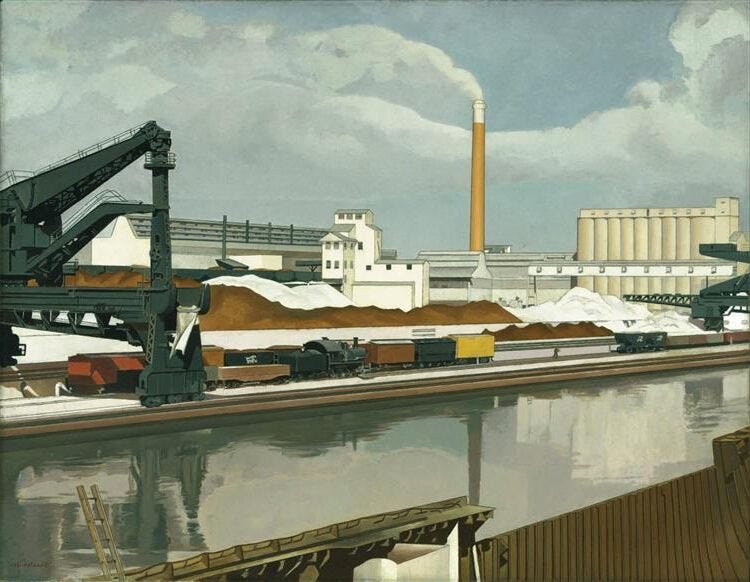
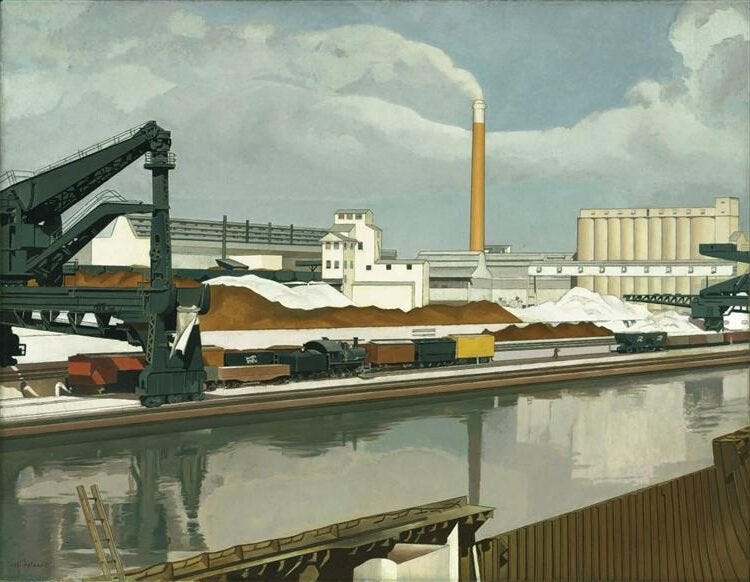
American Landscape (1930) by Charles Sheeler. Source.
The Lingao origin story, the BBS community, engineering experience, digging latrines
Afra: Let’s go back to the beginning of your participation in Morning Star of Lingao. Why did you get involved?
Ma: The question “why did you join” didn’t quite make sense at the time, because there was no project to join. It grew organically out of an internet forum conversation.
In the early days of the Chinese internet, when content moderation was still relatively loose, time-travel fiction was everywhere. But almost all of it followed the same template: a lone individual slips back in history and nudges events slightly in a different direction. No one was seriously asking what it would take to rebuild a civilization from scratch.
Then someone posed a more radical question: not “how do we tweak history,” but “how do we construct a new society inside it — from nothing”? How many people would that even require?
The answer was murky. Maybe a few hundred. These discussions were happening on SCBBS — one of the central BBSs of that era — and by coincidence, the people actively participating numbered roughly the same. So a writing mode emerged: each person would contribute a section, like a collective simulation, layering the world one post at a time.
So my role: I was a core participant in the early phase — the location of Lingao County in the distant Hainan Island was my choice — but the reason it cohered into a novel is that Xiao Feng commercialized it. He held final thematic authority. He made the project sustainable.
Think of the overall creative community as a dumbbell: one end was the spontaneous early writing; the other was the sustained creation around the established storyline. Xiao Feng anchored the latter; I played a significant role in the former.
Afra: You were on SCBBC from the very beginning, 2006 or so?
Ma: From the start. SC was among the most central forums in China at that time. I was socially well-connected there, vocal, and deeply interested in the subject. I was still working as a structural engineer then — the topic was right in my wheelhouse.
Afra: You were at the Suzhou Planning & Design Research Institute. Did your engineering experience make its way into the writing?
Ma: Not in the form of technical specifications. More as a kind of accumulated practical judgment.
Here’s an example. We had a premise: several hundred people arrive by ship, land on a remote island, and most are immediately swept up in excitement and ideology. The first thing I wrote was a recommendation to dig latrines. Because if hundreds of people are settling somewhere they plan to inhabit long-term — in a corner of a remote island in the seventeenth century — your first crisis isn’t political legitimacy. It’s infectious disease. Establish waste disposal, stabilize sanitation, and only then does everything else become possible.
But what I was really transmitting was something about organizational logic: in a group of hundreds, with no established authority, someone has to claim the unglamorous work first. That act of volunteering for the dirty job is how nominal authority becomes real. I’d organized student groups and managed engineering projects. The principle holds: declare your willingness to get your hands dirty, and leadership gradually crystallizes around you. It’s how any group moves from disorder toward structure.
Afra: So the toilet-digging in Lingao county is fictional — but it was performing a real organizational function, enacted through writing, right?
Ma: Exactly. If I were truly on that ship, at the center of things, what’s the first move that actually gets the team operational? That’s what I was working out. The fiction was a simulation of a real problem.
Afra: One of the things I find most fascinating about Lingao is that the active BBS participants nearly all have counterparts inside the novel. How far did the real and the fictional actually merge? And where did they come apart?
Ma: First, some context. In the relatively open era of Chinese internet discourse — roughly before 2011 — whatever the nominal topic, politics was always the silent subtext. It ran beneath every thread. The Morning Star of Lingao is, at its core, a sharply political novel.
There was enormous confidence in modern material civilization: a few hundred people, equipped with the knowledge and documentation of the early twenty-first century, really could reconstruct an industrial society in the seventeenth century in Ming’s China. But behind that confidence in material capacity was an unstated grievance: that China’s contemporary superstructure was unworthy of the productive forces it sat atop.
So the novel doesn’t reproduce China’s existing power structure. More than that, it attempts to make legible what political power actually is — though in retrospect, this was more collective unconscious than deliberate design. The writers didn’t theorize it; they just wrote what they felt.
The common thread, for everyone involved: pervasive dissatisfaction with the political status quo, and a desire which is encoded in the fiction, to build a polity actually commensurate with industrialization. One that might satisfy people who actually held advanced productive capacity.
Afra: Let’s go back to the early 2000s, when Lingao was just beginning to take shape on SCBBS. Internet access in China was still a privilege of the few: mostly urban, educated, technically inclined. What role did that early internet play in making Lingao possible?
Ma: It was the connective infrastructure. In a country where internet access was still scarce, the people who had it were disproportionately exactly the kind of people Lingao needed — engineers, STEM graduates, technically minded political obsessives. The network self-selected for them.
Before the internet, niche communities simply didn’t survive. If one percent of the population shared an unusual interest, the statistical odds of finding another person who shared it — in your city, in your circle — were negligible. No one to exchange ideas with, the interest quietly dies. The internet changed that arithmetic entirely. Even one in ten thousand, in a country of 1.4 billion, is a viable community. Search engines turned keywords into gathering points.
Lingao required exactly this: a scatter of people with overlapping, unlikely interests — engineering, history, political frustration, a taste for counterfactual speculation — who could, for the first time, locate each other. Without that early internet, the community evaporates before the first chapter is written. It was simply too small for the pre-digital world to hold together.
Afra: If you were writing Lingao today, what would you change?
Ma: Not much that’s fundamental. Xiao Feng held the pen, but the creative body was hundreds, perhaps thousands of people. What we collectively produced was: deep confidence in material progress, a serious attempt to grapple with social organization, and a shared unease with the gap between China’s productive capacity and its governing superstructure. That was our common memory and our collective unconscious.
Whether you go back five hundred years from 2026 or from 2016 doesn’t change the basic situation: that society’s productive forces are so low that you can design an industrial civilization on a blank page — hardware and software alike. The fundamentals don’t shift.
Afra: Scholars study Lingao now as a kind of emblem of China’s industrial awakening. How does that feel from the inside?
Ma: It makes sense. Lingao should have had successors — novels that continued its project, refined its arguments. But as it became a cultural phenomenon, the environment closed around it. And not merely the question of whether collective time-travel fiction can be published — we all know that answer. The deeper point is that Lingao‘s anxieties have been validated from both directions: China’s material productive forces have continued to advance; the superstructure has continued to lag. The question the novel raised: how do you build a rational political architecture commensurate with the actual forces of production, in a moment of radical upheaval? It has only become more urgent.
That question encompasses power, culture, and finance. Society keeps providing evidence, from every angle, that the cultural imagination of Lingao was asking the right things.
Afra: I’ve always read Lingao as a work of nationalist, industry-party wish fulfillment. But from what you’re saying, the nationalism seems more incidental than essential?
Ma: Nationalism is a modern invention, full stop. For the early-2000s cohort of Lingao writers, we were China’s nascent industrial bourgeoisie — I’m using the Marxist term without apology. A class forming a common interest requires an ideology that coheres it; given that this group shared an ethnic and cultural identity, nationalism was a natural, almost automatic expression.
But look at what happens inside the novel: almost immediately, the rhetoric of nationalism is overwhelmed by internal power struggles, departmental conflicts, factional maneuvering within the Senate. Nationalism as a mobilizing force requires a genuine external enemy. Lingao‘s time-travelers never really face one — and when governing a seventeenth-century population, the ethnic composition of the “natives” is simply irrelevant.
When you’re making bean curd, you don’t sort by whether the beans are yellow or green. They’re all beans.
Political philosophy of Lingao: transparency, productive forces, aristocratic rule, Marxism
Afra: The writers of Lingao set out to build a political utopia on a blank page, a system worthy of the productive forces they carried back with them. But reading the novel, what actually emerges looks less like utopia and more like a familiar arrangement: a closed elite of time-travelers running a semi-militarized regime over a population with no political rights (in other words, aristocratic authoritarianism). In structure, it’s not entirely unlike the system they were presumably criticizing. So what’s the substantive difference?
Ma: You have to define “progress” precisely. Progress means that the group that holds advanced productive forces is allowed to shape the political increment — the direction of change.
In contemporary China, the problem is stark: private enterprise, the engineering and technical class cannot participate in policymaking and deliberation. At most, they have a consultative role, and even that happens in opacity. In Lingao, the five hundred time-travelers and their archives represent productive forces five centuries ahead of their context. That the people who can actually interpret and deploy those archives must hold power — that itself constitutes progress.
Progress has never required majority rule. Historically, it’s typically been driven by minorities. In the most basic Marxist terms: whoever represents advanced productive forces should hold state power. Marx anticipated the proletariat as history’s chosen agent; the actual course of events has not been so tidy.
Lingao achieves at least two things. First, it’s more consistent with the logic that advanced productive forces should govern. Second, it’s transparent. Transparency means modifiability. A machine with no manual can’t be repaired. In the novel, “natives have no rights” — stated plainly. You may find that objectionable. But the willingness to state it is itself a form of progress.
Lingao insists on both: advancing productive capacity and describing power with transparency. I’d argue it’s a more faithful interpretation of original Marxism than most of what gets produced by official propaganda organs.
Afra: Do you consider yourself a Marxist?
Ma: I think I’m one of the rare people in China who has maintained something close to original Marxism, consistently, over several decades.
Wenzhou high-speed train crash, the “industry party” label, media as rational actor, populism vs. democracy
Context: In July 2011, two high-speed trains collided near Wenzhou, killing forty people and injuring nearly two hundred. The crash became a cultural flashpoint — a vocal segment of Chinese media used it to indict the entire logic of infrastructure-driven development, framing state ambition against human cost. Against this, a loose counter-current emerged that insisted on comparing rail fatalities to the far larger toll of road traffic, and remained broadly confident in industrial transformation. This tendency acquired a name — the “Industrial Party” — and Ma Qianzou became one of its most recognizable voices.
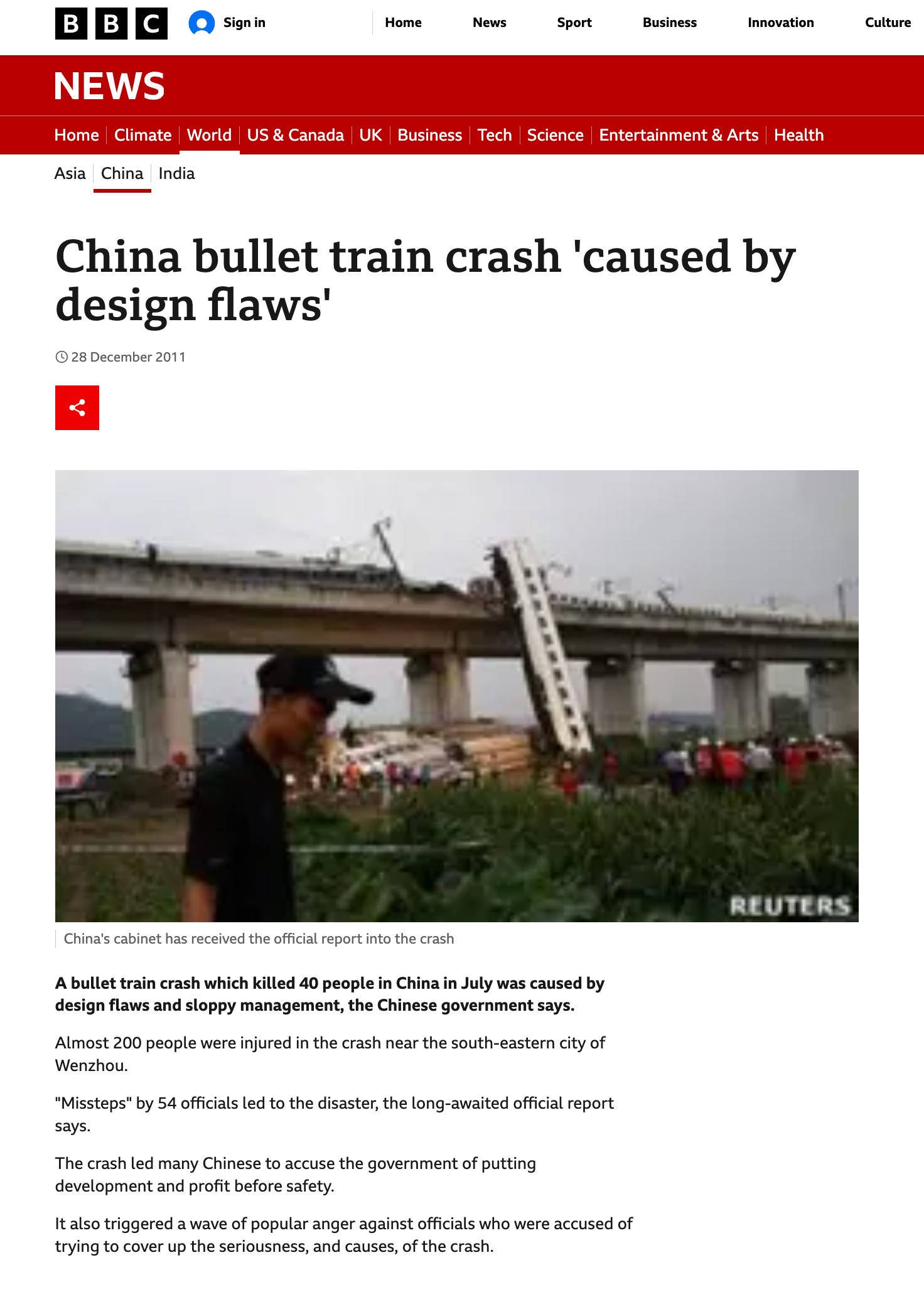
Afra: I want to move to the 2011 Wenzhou high-speed rail crash. Many people mark that as your breakthrough moment.
Ma: I’d say more accurately: I leveraged the platform of Guancha. My media career divides roughly in half — the first seven-plus years as an editor at Guancha, the latter seven-plus years with my own Bilibili channel. Wenzhou was a moment of seizing media oxygen.
Afra: What was your actual argument about Wenzhou? And was the “sentimental party versus the industrial party” framing accurate?
Ma: That framing was problematic. The only real standard is: does the analysis correspond to reality? My understanding of good media is this: you feature rational content, but delivered with as much emotional force as possible to be persuasive. Of course you select the most arresting images, the most resonant human stories — people are affective and emotional creatures, and good media knows how to hack the emotions. But the people making editorial judgments must be operating rationally.
After Wenzhou, the implicit argument from much of the media was: the nation should shift away from building more high-speed rail, embrace private car culture. But if you actually run the statistics, that transition produces far more deaths over time. Major infrastructure projects like high-speed rail carry inherent risks; you cannot condemn the entire enterprise because of a concentrated tragedy like what happened in Wenzhou.
If you’re genuinely committed to humanist values, you have to represent all the deaths — including the hundreds of thousands killed annually in road accidents by private cars, who don’t make for dramatic news coverage and can’t advocate for themselves. Most media were only voicing the visible catastrophe. The statistical dead had no representatives. That’s theatrics. That’s not humanitarianism.
Regardless of medium, media that trades in emotional gratification at the expense of analysis is a dereliction. The same impulse led people to use Wenzhou to indict high-speed rail as a project — while the people who would have died on roads remained, as always, invisible.
Afra: Did you realize at the time that you were being absorbed into an “Industrial Party” identity?
Ma: I’ve consistently rejected that label. What I recognized in 2011 was that most Chinese people hadn’t yet absorbed the fact that they were living in the world’s largest industrial economy — or reckoned with what that transformation demanded of them. My position has always been the same: face reality, and say what most people aren’t saying. In 2011, that meant foregrounding industry. If tomorrow the majority falls into an industrial fetishism that treats investment as inherently virtuous regardless of returns or human welfare, I’ll argue the other way. I don’t have a brief for industry. I have a brief for accurate analysis, and accurate analysis changes depending on what the moment is getting wrong.
Afra: But “standing with the majority” sits uneasily alongside Lingao‘s fictional aristocratic model, where a small elite of advanced-knowledge holders governs people without rights. How do you hold those together?
Ma: For the people Lingao depicts — serfs and peasants in the Ming dynasty, without political rights of any kind — being governed by an efficient, knowledge-holding administration is progress. Liberation from the old structure comes first.
But more fundamentally: “standing with the majority” and “facing reality” are inseparable. You have to help the majority understand where they actually stand in the productive order. If a country has hundreds of millions of farmers clinging to small plots and using conservative politics to resist industrialization, standing with the majority doesn’t mean validating their condition. It means being honest about what that condition actually costs them.
Zhu De, the CCP general who fought with Mao, writing about his own family, describes children being drowned at birth when there were too many mouths to feed. Traditional agrarian society, by modern standards, is a society that does not recognize human life as such. When the majority has been shaped by that structure and has absorbed it as natural, genuinely standing with them means insisting on the productive forces that would transform it, not flattering them.
And: whoever actually holds those productive forces must lead the transition. The majority aligns toward that capacity. That’s the distinction between democracy and populism. Democracy asks the majority to acknowledge reality and make rational decisions. Populism flatters the majority’s existing emotions and accelerates along the existing inertial path. I’m with democracy.
Afra: So the “sentimentalists” or the humanitarians were, in your reading, essentially practicing populism?
Ma: There isn’t really a “sentimental party” as a coherent entity. It’s a predictable symptom of a particular media environment. In mainland Chinese media, without a press law, without enforced standards of factual accuracy, the market is easily captured by what I’d call script writers — people producing dramatic narratives rather than analysis. The regulatory apparatus doesn’t police this.
I said last year: China has one and a half journalists actually generating genuine public discourse — I’m one; Hu Xijin is the half. The remaining several million media workers collectively add up to zero. I still hold that position in 2026.
Afra: What about someone like Chai Jing?
Context: Chai Jing is perhaps the most celebrated journalist of her generation in China — a former CCTV anchor whose 2015 self-funded documentary on air pollution, Under the Dome, drew hundreds of millions of views before being scrubbed from the Chinese internet within days. She has lived in self-imposed exile in the United States since, with a YouTube channel of 1.1 million followers.
Ma: Chai Jing has no public voice in China anymore. I said that in 2024. She may exist as a kind of ghost in the internet’s memory, but she’s not functioning as a journalist. What I’m claiming is that my show is the only national editorial voice currently operating in China. I don’t see a second one.
Afra: Did the argument for high-speed rail ultimately succeed? Did you change anything?
Ma: There was real influence, but “success” is mostly a matter of riding the current. Over the long run, the side with advanced productive forces wins. The national high-speed rail network would have been built without me. But if I accelerated the process even by a fraction of a percent — in a project involving millions of lives and hundreds of millions of users — that fraction has weight. What I wanted was for the transition to carry less unnecessary suffering: fewer people making futile stands against something that was coming regardless.
AGI timeline, human bifurcation, mass displacement, the brain’s peripheral device, longevity
Afra: China’s industrial plan frequently references “advanced productive forces,” a concept often echoed by Xi Jinping’s emphasis on “new quality productive forces”. This leads directly to a topic I find most compelling: AI. How do you anticipate AI will impact Chinese society?
Ma: Human bifurcation is already underway. AI is one dimension of it — the systematic displacement of baseline cognitive and logical labor.
You don’t have to look to the present to see this coming. About a decade ago — I can say this privately — a senior official from the Cyberspace Administration gave a talk in Beijing. He held up a newly released smartphone and asked the room: what is this? Someone said, a smartphone. He said: No. This is a peripheral device for the human brain.
His point was blunt: the divergence had already begun. The gap between people who could interface with a vast information infrastructure at any moment and people who couldn’t was, in his framing, approaching the distance between humans and great apes. Many people, he implied, would cease to qualify as fully human in any socially meaningful sense.
That framing has essentially held. Back then it was smartphones and search engines. Now it’s AI. The bifurcation is accelerating, and most people will fall below the threshold.
But this is not historically unprecedented. Before the Industrial Revolution, the world had fewer than a billion people, and the overwhelming majority were agricultural laborers. The Revolution and the Age of Sail together transformed everything. Colonial expansion opened what seemed like inexhaustible arable land; commercial agriculture globalized; the Chinese countryside — Lu Xun captured this in “A Good Harvest” — found that even a surplus couldn’t be sold, because imported grain had undercut the market. When British textiles began flooding South Asia, Bengali weavers didn’t just lose their livelihoods. Contemporaries described their bones bleaching the plains.
Agrarian societies cannot, within a single generation, transfer millions of people from one distributive system to another. The historical norm is: many of them die. The elimination of majorities by minorities has happened before. It happened when agricultural populations displaced hunter-gatherers.
Afra: So you’re expecting something genuinely brutal — an unvarnished culling?
Ma: Or an opportunity, depending on your position. The rational response is to encourage two things: maintain genuine cognitive capacity, and accept that in summarizable, repeatable tasks, AI is simply better than you. The analogy to physical labor holds: two hundred years ago, people had to internalize that brute strength no longer determined economic survival. You had to break out of what had previously constituted competence.
My way of “standing with the majority” is to say, clearly: here is where your inertia will cost you. Move faster.
And to be honest: many of the professions AI is now displacing should have been eliminated long before AI arrived.
When I was at the Suzhou traffic design institute in 2003, we were building small Excel programs to replace standardized calculation documents — logic trees that could absorb field data and produce results quickly. My manager said explicitly: whoever can use Excel to build a semi-automatic calculation system gets 100,000 yuan a year. You have to understand what 100,000 yuan meant in 2003.
But in most companies, sixty percent or more of the staff were people whose work consisted of applying experiential pattern-matching to inputs and producing outputs — qualitative or quantitative. By my reckoning, those jobs could have been automated with 2005-era technology. The only thing that preserved them was the cost of human communication: the ability to receive verbal instructions from a supervisor, the social lubrication of having a warm body to send on an errand.
AI now processes speech. The last protective moat has been breached. These jobs were always going to be buried; 2026 is just when the funeral is happening.
Afra: How do you think about AGI? Is China actually pursuing it?
Ma: If you’ve understood what I’ve been saying, the AGI question is almost orthogonal. Even if global productive capacity had frozen in 2010 and never advanced further, the majority of people would still be rendered economically redundant — just more slowly. The relevant threshold has already been crossed.
The difference between 99 percent eliminated and 99.9 percent eliminated is not meaningful. Whether it happens in 2026 or 2036 is not meaningful.
Everyone is pursuing AGI. The outcome doesn’t bend to the preferences of minorities. The Industrial Revolution never asked other civilizations whether they were ready; the result was that they either embraced industrialization or were consumed by it. We’re at an analogous juncture.
AGI may or may not be achievable — I genuinely don’t know — but that uncertainty is irrelevant to the current situation. The AI we already have is sufficient to displace 99 percent. I don’t hire research assistants anymore. For finding sources, summarizing documents, doing initial review — AI is adequate.
Afra: How do you assess the government’s push around what it’s calling xinzhi shengchanli — “new quality productive forces”?
Ma: Every government advocates for advanced productive forces. No one campaigns for backwardness. This is the contribution of the French Revolution to world political culture: even North Korea calls itself a democratic republic.
Genuine commitment to advanced productive forces requires two things: first, equipping the majority with the capacity to compete; second — and more politically costly — ensuring that the groups actually holding advanced productive forces get real investment authority, not just a consultative role.
The willingness to say hard things is the test. Can you actually acknowledge that a majority of the current workforce will become economically superfluous? You can phrase it tactfully, but the substance has to be there. If it isn’t, what you have is performative encouragement.
What distinguishes useful advice from useless advice? Someone in the forest: telling them to “try hard to find the path” is useless. Telling them to find water, follow it downstream, because rivers lead to settlements — that’s a navigable instruction. Good media offers navigable instructions. That requires naming things that are wrong, which means making enemies. If you won’t make enemies, you’re not doing the work.
Afra: How do you read China’s current position — industrial overcapacity, local government debt, a real estate crisis, while simultaneously promoting “new quality production force”?
Ma: The most fundamental question for any administrative system is whether rewards and punishments are calibrated correctly. Which officials were promoted during the previous cycle? Have any of them been held accountable for the overinvestment and real-estate dependency that produced the current crisis? No. Which means there has been no real reckoning.
A bureaucratic system is only sensitive to incentives — I’ll put it plainly: it responds to the stick and the treat, and to nothing else. Without recalibrating the reward structure, no amount of rhetorical reorientation will shift behavior. The transition will still happen — advanced productive forces always win — but the trajectory will carry more unnecessary suffering. The question is whether anyone administers anesthesia intelligently, or whether people are left to absorb the full shock without preparation.
This world may be only twenty-four months from rupture. I don’t spend much energy on long-cycle risks — only on what could materially affect me in the near term.
Afra: Why twenty-four months?
Ma: Same argument. AI didn’t create the conditions for mass displacement — it just punctured the membrane that was holding them in place. The jobs being eliminated were already structurally unnecessary; they survived on the friction costs of human communication. AI has removed that friction.
Two years, maybe five. But I believe that by 2030, 2035, this world will be categorically different.
In 1992, when I finished primary school, I was out in my teacher’s cornfield digging up root stumps. The stalks had been taken for fuel; the roots were left frozen in the ground because they were too much trouble to remove. We extracted them — half went to the teacher as a kind of rent, half went to heat the classroom through winter. That was 1992.
We are now in 2026. Thirty years have been turned upside down. And I believe the next five to eight years will produce more disruption than the entire previous thirty.
Afra: What’s your priority right now, if you believe the AGI disruption is two years away?
Ma: Exercise. Specifically: improve my health. The larger the upheaval, the longer the uncertainty. As a human, not as an influencer or public intellectual, the most important thing is to be physically present for more of it.
Let me tell you a footnote about Lingao‘s rise. Beyond the community word-of-mouth, there was a structural reason it broke through: a deputy editor at Qidian was personally a fan and used his discretionary authority to give it prominent placement. He told me once, with complete seriousness: “In the entire history of written Chinese, there has been exactly one successful ensemble novel — Water Margin. I’m giving Lingao a chance to be the second.”
That editor later worked under Chen Tianqiao. Chen Tianqiao is one of the very few Chinese billionaires who managed to leave China with capital intact — becoming wealthy in China isn’t especially difficult; leaving with the money is. He’s made substantial early investments in the United States, heavily concentrated in life sciences. The implication is clear: he believes longevity technology has reached a meaningful threshold, and he’s buying in.
Afra: There’s a parallel between the world you’re describing and a certain strain of thinking in Silicon Valley right now, many prominent figures are pouring money into longevity research. Chen Tianqiao, whom you just mentioned, and other wealthy business people in China seem to be making a similar bet. Does that vision of immortality appeal to you?
Ma: It’s not within reach for me. But beyond that — not especially. Growth, in any meaningful sense, requires forgetting. The reason you become yourself is partly that you don’t carry intact memories of being three years old. Indefinitely extending memory doesn’t appeal to me as a project.
What I want is to see what happens next. Which is reason enough to stay physically capable.
When I list exercise as my first priority, I’m also conceding something: I don’t have much capacity to shape what’s coming. Journalists are constitutionally observers. And I’m operating in a country with an acutely distorted media environment — I believe I’m running the only nationally significant editorial voice in China, but there’s no press law, no formal protection, and the informal protection I have can’t be discussed publicly.
Professionally, I’ve reached what I’ll call a monopoly position — small as that monopoly is. What do you do with a monopoly? You defend it. Current media regulations effectively guarantee that there will be no second Qian Mian Xinxi — just as there will be no second Lingao. When you occupy a position like that, maintenance becomes the strategy. That’s my plan for the next several years.
Censorship, the black room, navigating the Chinese media environment
Afra: As an influencer, you’ve faced censorship over your positions on the Russia-Ukraine war. And you have been cancelled by the censors before, right? What effect has that had on you?
Ma: I receive roughly one legal notice or formal complaint from a major corporation or local government per week. Every three to four months, I experience a significant deletion or suspension. Which specific incident shaped me? I don’t find the question useful. Most Chinese journalists have never encountered this. For me it’s the baseline of the work — like asking what I had for breakfast. I ate; tomorrow I’ll eat again.
Afra: How do you navigate survival within that system?
Ma: This isn’t something I can describe usefully, or that it would be appropriate to share in full — maybe in memoirs, twenty years from now. But I’ve used a metaphor before that I can repeat:
When I previously did an interview, I used this metaphor: China’s media landscape is like a dark room with ten pieces of furniture you are not allowed to bump into. The furniture is not necessarily placed there on purpose, but it is there. The rules of the game are like this: you walk in, the door closes, and you move around. If you kick one of the pieces of furniture and shout, you are out of the game.
But because of my previous media credentials, I can “intern” in that dark room. Even if I bump into a piece of furniture, I do not necessarily get kicked out immediately. After some time, even though the credentials are gone, I have accumulated experience, and I will never kick the furniture and shout again.
Of course, this is not some exclusive technique. In China, there might be dozens, perhaps hundreds, of people who have accumulated similar experience. But they are not interested in continuing to work in the dark room, because it does not make big money, and it still carries safety risks.
Among those who have the technique, I seem to be the only one willing to stay and do this kind of work.
Read the English translation here: https://illuminelingao.com/
A Yale class assigned it. A European journal commissioned a follow-up. Kaiser Y Kuo (link) and Kyle Chan (link) invited me on their podcasts. Chinese readers translated and circulated it inside the firewall.
This guy is insanely politically conscious. Really a pleasant surprise to discover a voice like his.
Apologies if you answered this but is the book available in translation? You make it sound fascinating!