

AI Prophecy from Hangzhou
China's first ASI evangelist, Alibaba's Yunqi Conference, more vibe shift

I feel hesitant to write about certain Chinese tech launches because I often get bored with the particularities: the parameters of this model, the FLOPS per watt efficiency metrics of this semiconductor architecture, the rack density specifications of that hyperscale data center deployment. I get it—they’re impressive. But I usually seek only one thing: what future-pills people the most?
I rarely get future-pilled by Chinese AI companies. I’ve written before that AI technologists in China are utterly utilitarian and practical. There’s what I call an AGI “faith gap”—people don’t believe in it, but constantly talk about this buzzword. What I’ve observed is that a deeper epistemological divide shapes how each culture approaches technological prophecy:
Silicon Valley’s AGI discourse operates like what Kevin Kelly calls “technium” thinking—technology as an autonomous force with its own evolutionary trajectory. Chinese tech culture, by contrast, remains fundamentally instrumentalist.
The manufacturing advantage directly creates a scene where Chinese founders focus on AI hardware, consumer apps, SaaS (but only targeting overseas users), and open-sourced LLMs that are cheaper to train and more efficient. Less focus on debates about doomerism and superintelligence races.1 Big tech CEOs love keywords like “empowering thousands of industries” and “inclusive AI,” rarely discussing surpassing humans or cosmic ultimate questions. In China, we struggle to find equivalents of polymathic leaders like Demis Hassabis or prophets like Ilya Sutskever—people who understand foundational AI technology while constructing fearsome yet alluring AI futures in others’ minds. Not to mention a Chinese Eliezer Yudkowsky or Jaan Tallinn who focus on existential risks.2
But that seems to be changing.

The Hangzhou Prophet
Today at Alibaba’s 2025 Yunqi Conference—an annual mega tech gathering since 2009, similar to WWDC or Google I/O—I watched the CEO Eddie Wu deliver something I wouldn’t expect. The entire speech was devoted to “ASI-pilling,” marking the first time a major Chinese tech company has seriously evangelized Artificial Super Intelligence, which is a remarkable departure from the cautious, instrumentalist rhetoric that has dominated Chinese tech discourse.
“Achieving AGI—an intelligent system with human-level general cognitive abilities—now appears to be a certainty,” Wu said. “However, AGI is not AI’s endpoint, but a new beginning. AI will not stop at AGI; it will advance toward artificial superintelligence (ASI) that surpasses humans and can self-iterate and evolve.”
Wu mentioned ASI will be able to connect to the complete raw data of the real world, instead of using humans as intermediaries—transforming what Balaji calls the “middle-to-middle” phase to true end-to-end.
He used a car manufacturing example: instead of a CEO iterating next year’s product through countless user surveys and internal discussions (all secondhand data), an ASI with access to all automotive data could design and create vehicles “far superior to anything from brainstorming sessions.” I appreciate the concreteness—cars are a deeply tangible industry, and one where China already holds an unrivaled advantage in scale, supply chains, and speed of iteration. That makes this imagined future feel unusually close at hand. I am very future-pilled by this scenario.
Wu is one of Alibaba’s founding “Eighteen Arhats” and has long been seen as technically-minded and reserved. He rarely speaks publicly, earning the nickname “Alibaba’s most mysterious Arhat.” From 2004-2011, he headed Alimama (Alibaba’s advertising platform), getting him the moniker “Mom Wu.”
His ASI declaration at this conference represents quite an unusual departure—a stark contrast to years of silence that maybe signal a vibe shift in Chinese tech discourse.
The Long Silence and Its Breaking
After Jack Ma’s 2020 speech challenging China’s regulatory system before Ant’s IPO, the storm that followed saw the planned $300 billion offering—history’s largest IPO—abruptly canceled. Since then, Alibaba entered a prolonged “silence period” where big companies stopped articulating grand future visions, pivoting to emphasize compliance and stability. The narrative energy that once powered declarations like “making business easy worldwide” was drained.
The chill went far beyond Alibaba. In 2021, regulators launched the “disorderly expansion of capital” campaign, reining in platform companies from ride-hailing to e-commerce. Didi went public in New York only to be swiftly pulled into a cybersecurity investigation and fined $1.2bn. Education tech giants like New Oriental and TAL got nuked overnight under the “double reduction” policy. Even Meituan’s Wang Xing triggered scrutiny when a Tang dynasty poem he posted online was read as oblique criticism of the state.
Since then, many tech founders feared saying the wrong thing in public, replaced by cautious technical jargon or collective silence, creating today’s extremely asymmetrical information flow where Chinese founders study Silicon Valley surgically, but not the other way around.
The DeepSeek moment changed everything. In late 2024, this Chinese AI lab quietly released models that matched frontier performance while using dramatically less compute and training data than their Silicon Valley counterparts. The implications were immediate: Chinese AI capabilities had been systematically underestimated, and the supposed resource advantages of American tech giants suddenly looked less decisive. Since then, I’ve observed a vibe shift. In China, a giant wave of techno-nationalistic discussions permeates the internet, with people believing “China’s tech rise is national destiny.”
Meanwhile in Silicon Valley, I found abundant China curiosity mixed with China envy—mainly across the broader hardware and manufacturing domains where China has established leadership.
Silicon Valley is trying to reverse-engineer their own path from China’s tangible tech achievements: a16z started advocating that America needs to build its own BYD with a complete Electro-Industrial Stack in their American Dynamism article; we see the launch of the “American DeepSeek” open-source projects attempting to replicate Chinese AI efficiency; Noah Smith stated that Western re-industrialization strategy directions are now “bleedingly obvious”—just look at what China is betting on: batteries, electric motors, power electronics, and chips. Dan Wang’s book Breakneck became an unprecedented intellectual phenomenon, propelling people to ask: how can we transform a lawyerly society into an engineering state so our taxpayer money can turn into more damn high-speed rail?
However, at Alibaba’s conference, I could see an even longer-term vibe shift—and maybe eventually a paradigm shift. Previously, Chinese companies in global tech narratives were often treated as deployment engines: able to manufacture quickly, iterate rapidly, catch up efficiently, but lacking roles that truly shape imagination. Wu’s ASI speech represents a breakthrough: while the “AI-infused future society” is still taking shape, major Chinese companies are beginning to articulate their own grand visions that carry the flavor of future prophecy.
If this trend continues, we might witness new symmetry in AI discourse: no longer just Silicon Valley exporting techno-prophecy to the world, but Chinese companies proposing equally compelling world-building narratives. That alone feels like a shift worth noticing.
China’s AI Bubble
But Wu’s sci-fi vision exists in tension with what I saw on the ground during five weeks in China this August and September. Walking through AI startup circles and innovation parks in Shenzhen, Shanghai, and Beijing—drinking custom “DeepDrink” at Beijing’s AGI Bar (covered in terrible Chinese tech memes)—I felt like AI was everywhere, but also nowhere real.
Take Midea’s latest “DeepSeek AI air conditioner”—it looked exactly like any ordinary air conditioner, just slapped with an AI label. Shanghai Museum’s “AI smart guide” was essentially a clunky LLM connected to a regular domestic smartphone, packaged as essential smart city infrastructure (I just don’t know how much this government contract cost, or which company landed the lucrative deal with the Shanghai government). I also visited Shanghai’s Mosu Space, a government-led AI accelerator, where the so-called “smart mirror” in the exhibition hall simply detected whether you’d applied sunscreen evenly on your face; the so-called “AI glasses” were just a gadget connected to smartphones that projected screen content in front of your eyes (Xi Jinping actually wore these glasses during his May visit). These products had virtually no real utility—they were using “AI” as a gimmick to satisfy policy directives and funding requirements.


Even when I got inside Shanghai’s sprawling “AI Town”—and I mean sprawling, like this massive campus that stretches beyond what you can see—I found the famous Innovation Institute buried somewhere in the middle of it all. Picture dozens of gleaming buildings, some still wrapped in construction scaffolding, others already finished but weirdly empty. The scale is honestly hard to describe unless you’ve walked through it yourself.
The AI founders and researchers I talked to there were pretty candid beneath all those glossy exhibition boards promising the future. They’re still glued to whatever’s happening in Silicon Valley, ready to sprint after the next breakthrough. That old reverence for the Valley is still everywhere.
When I asked one AI professor who works at the Innovation Institute what he thought about this whole surreal project. He just shrugged and said, “It’s just real estate.” It’s another layer of China’s real estate oversupply problem, dressed up in tech buzzwords. You’ve got this massive development with more buildings than they know what to do with, half-empty despite all the investment.
The AI story is fascinating because of its wild complexity and its propositional stance toward this complexity. When I was reading the book Supremacy by Parmy Olson, I got mesmerized by the motivation differences between DeepMind’s three founders in the early days. “Legg moved in circles where the goal was to merge as many people with AGI as possible, Suleyman wanted to solve societal problems, and Hassabis wanted to go down in history having made fundamental discoveries about the universe.” They started arguing with each other—but the bigger picture they all acknowledged was the world’s complexity outpacing anyone’s ability to control it. AI is deeply embedded in problems that are fundamentally non-linear and unpredictable.
I’m still surprised to find myself getting future-pilled by AI developments so many times I’ve lost count, yet each time still feels different. Maybe that’s why I can’t quit this beat. AI stopped being just technology somewhere along the way—it became the rehearsal stage where both my worlds practice their lines about tomorrow. As someone doomed to live in the between-space, I’ve started to think that this entanglement—half exhilarating, half exhausting—might be the most honest place to observe from.
Wu’s rhetoric might sound overwrought or derivative to Silicon Valley ears—after all, we’re practically drowning in tech prophets here, so why do we need another one from Hangzhou? But consider this an elementary-level Chinese technologist learning to LARP as someone like Kevin Kelly, and you might surprisingly get future-pilled again like me.
Below is Wu’s complete keynote address. As you read it, notice how it borrows heavily from Silicon Valley’s apocalyptic optimism while grounding everything in China’s reality. You don’t need to be impressed by the originality in Wu’s vision, but in the shift it represents: this is their own version of the future.
Keynote: Roadmap to Artificial Superintelligence (Transcript)
by Eddie Wu, CEO of Alibaba Group3, September 24, 2025
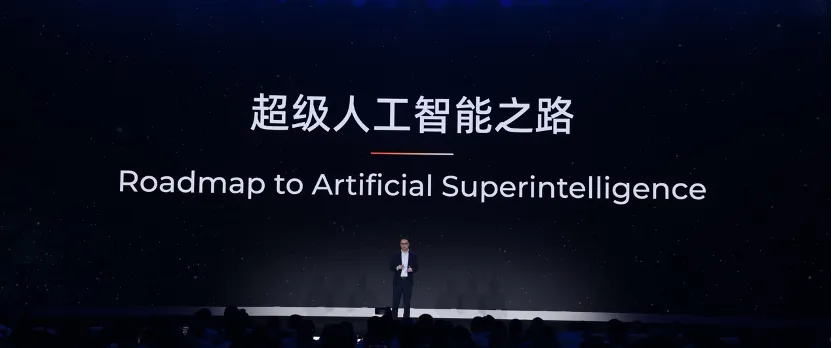
A new revolution is just beginning—a revolution of intelligence driven by artificial intelligence.
Over the past few centuries, the Industrial Revolution magnified human physical strength through mechanization; the Information Revolution expanded our capacity for processing information through digitization. But this time, the revolution of intelligence will exceed anything we can imagine.
Artificial General Intelligence, or AGI, will not only amplify human intellect but also liberate human potential—paving the way for the arrival of Artificial Superintelligence, or ASI.
In just the past three years, we have felt its pace clearly. In a handful of seasons, AI’s cognitive ability has leapt from the level of a high school student to that of a PhD graduate—capable even of winning gold at the International Mathematical Olympiad. AI chatbots have become the fastest-adopted consumer application in human history. The speed of industry adoption has surpassed every previous technology. Token consumption doubles every few months. In the past year alone, global AI investment exceeded 400 billion US dollars; over the next five years, cumulative investment will surpass 4 trillion—the largest single infusion of capital and compute power in history. This will inevitably accelerate the emergence of more powerful models and hasten the spread of AI across every domain.
Achieving AGI—an intelligent system with general human-level cognition—now appears inevitable. Yet AGI is not the end of AI’s development, but its beginning. AI will not stop at AGI; it will march toward ASI—intelligence beyond the human, capable of self-iteration and continuous evolution.
AGI will free us from as much as 80% of routine tasks, allowing humanity to concentrate on creation and exploration. ASI, by contrast, will generate “super-scientists” and “full-stack super-engineers,” capable of solving problems at speeds we can scarcely fathom: curing diseases, inventing new materials, achieving sustainable energy breakthroughs, addressing climate change, even venturing into interstellar travel. ASI will drive exponential technological leaps, carrying us into an unprecedented age of intelligence.
We believe the road to ASI will unfold in three stages.
Stage One: Emergence of Intelligence — “Learning from humans.”
The growth of the Internet over past decades has digitized nearly the entirety of human knowledge, preserved in language and text. Large models trained on this corpus acquired generalized intelligence, emergent abilities in conversation, and the capacity to understand human intent, answer questions, and begin reasoning across multiple steps. Already, AI systems are reaching gold-medal performance on the world’s toughest exams. This has opened the possibility of solving real-world problems and creating tangible value.
Stage Two: Autonomous Action — “Assisting humans.”
At this stage, AI moves beyond language alone. It acquires the ability to act in the real world: decomposing complex goals, using and even creating tools, and interacting with both digital and physical environments. The key lies in tool use. Just as human evolution accelerated when we learned to make and wield tools, models now gain transformative power by learning to do the same. With tool use, AI can call software, APIs, and devices to execute sophisticated tasks.
Another breakthrough is coding ability. To handle longer, more complex tasks, agents must be able to code autonomously—functioning like a team of engineers, able to interpret requirements, write, test, and iterate. Natural language will become the source code of the AI era. Anyone, in their mother tongue, will be able to summon an agent: “Tell the AI what you need, and it will design the logic, build the system, call the tools.” This stage will unleash productivity gains across logistics, manufacturing, software, commerce, biomedicine, finance, and beyond.
Stage Three: Self-Iteration — “Surpassing humans.”
This stage depends on two breakthroughs:
Connection to the full breadth of real-world data. Today’s AI excels in text-bound domains like content creation, math, and coding, where it has access to raw human-created data. But for the physical world, AI often sees only second-hand summaries. To truly transcend human cognition, it must engage directly with the raw signals of the world.
Self-learning. With real-world interaction, AI will be able to refine its models autonomously—building infrastructure for its own retraining, optimizing data flows, and upgrading architectures. Each action and feedback loop becomes a micro-adjustment; millions of such iterations accumulate into a self-evolving system. Out of this process, early forms of ASI will emerge.
At the moment of singularity, humanity will feel the acceleration of history itself: technological progress advancing beyond imagination, unleashing new productivity that carries us into a new stage of civilization.
From our perspective, large models will become the next generation operating system. In this analogy:
Natural language is the new programming language.
Agents are the new applications.
Context is the new memory.
The large model is the OS, linking tools and agents as the PC once linked software and hardware.
Software as we know it will be absorbed. Anyone will be able to create applications in natural language. Hundreds of millions of potential developers will enter the field. Every user will become a maker.
This future demands infrastructure of immense scale. AI will become the electricity of the new era—the essential commodity powering every industry. Most AI capability will be delivered as tokens across global networks. Tokens are the new electricity.
Alibaba Cloud positions itself to build this foundation: an open platform for developers, the Android of the AI age; and a super AI cloud, one of the few on earth capable of vertical integration from chips to models to global-scale data centers. We are investing 380 billion RMB over three years into this vision, building the supercomputing power and global network needed to welcome the ASI era.
When ASI arrives, human-AI collaboration will reach a new mode. Already programmers glimpse the future: a single instruction at midnight, a fully functional system by dawn. This is the seed of a new paradigm—from vibe coding to vibe working. Families, factories, companies—all will teem with agents and robots working alongside us. Perhaps one day, every individual will wield the power of a hundred GPUs, amplifying human intellect as electricity once amplified muscle.
Every revolution has expanded our capacity, and every expansion has revealed new horizons. This is only the beginning. AI will reshape infrastructure, software, applications—the entire substrate of society. Together with our partners and customers, Alibaba will invest, build, and co-create, bringing intelligence into every industry.
Thank you, and may you enjoy a rewarding Yunqi Conference.
Matt Sheehan’s piece on China’s newest national AI+ policy also mentions:
the document doesn’t cite AGI as the driver of these changes, and it pays relatively little attention to frontier AI development in general. Instead, it’s focused on how the AI of today-ish can be leveraged to achieve the CCP’s economic, social and political goals.
Eliezer Yudkowsky is an American AI researcher and writer, one of the earliest and most outspoken proponents of the view that advanced AI could pose an existential risk to humanity. Jaan Tallinn, co-founder of Skype, has become a leading funder and advocate of AI alignment research, supporting institutions such as the Future of Life Institute and the Centre for the Study of Existential Risk. I mention them here because they represent a distinct intellectual role in the Western AI ecosystem: figures who are not just technologists or entrepreneurs, but also quasi-philosophical voices, evangelizing the long-term risks and metaphysics of superintelligence. In China, by contrast, such public “prophets” of AI—half technical, half moral—are notably absent.
I’ve gotten a sense that Liang Wenfeng himself has been AGI-pilled for a while, but he’s a Weird Dude™️. It seems like the new shift is that Liang is no longer the outlier so much as the vanguard for something bigger than Deepseek.
this is a great piece Afra! Having been born in Hangzhou and witnessed its transformation over the past decades, from scenic Marco Polo/Song Dynasty tourist hotspot, to pre and post Alibaba and Deepseek each in turn, its been so interesting to see how the city has changed.