


I published a piece last week in Noema. I’d invite you to read it.
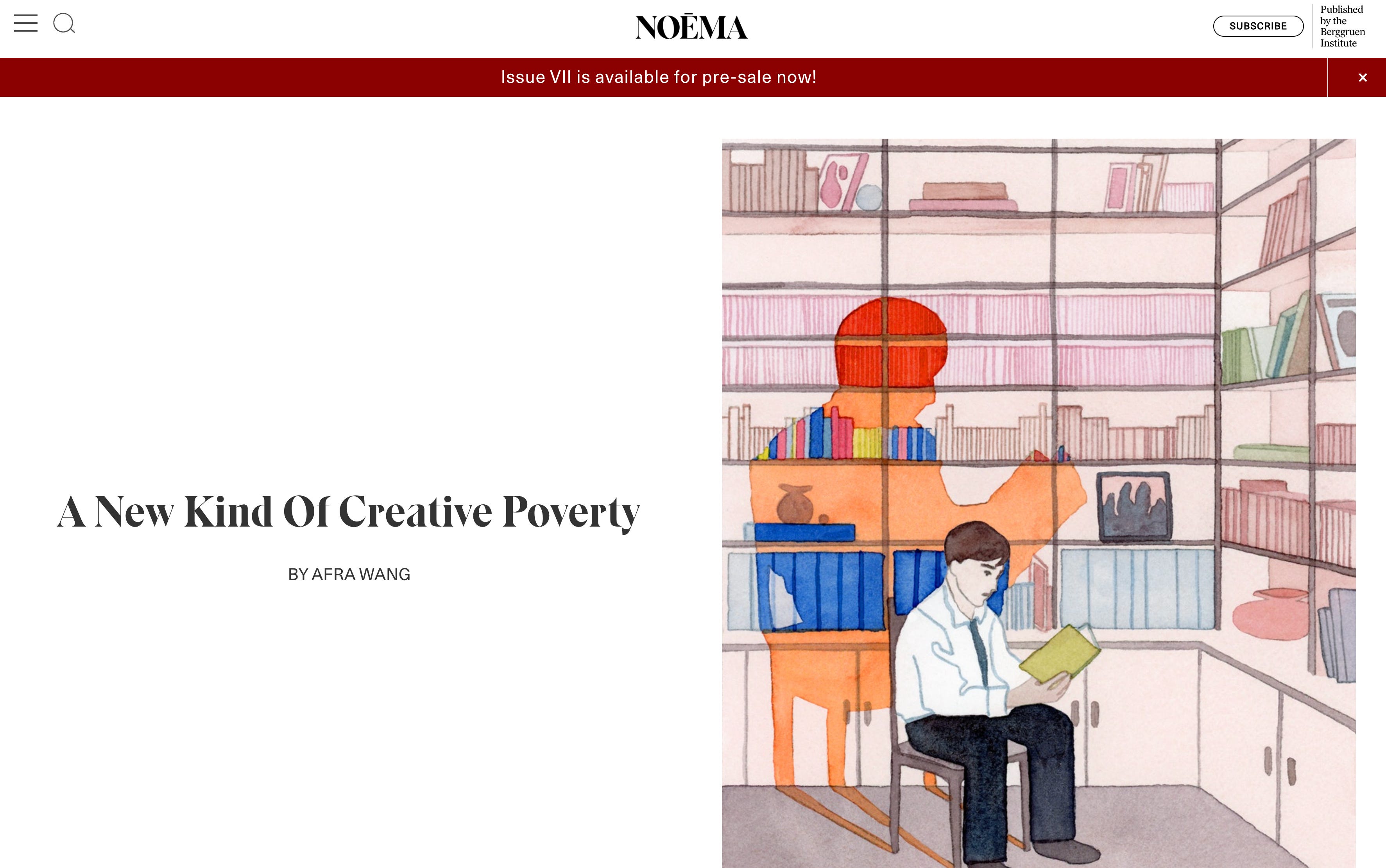
What do LLM writing and the mainland Chinese internet have in common?
My answer is neither can afford to be dangerous.
What I mean by dangerous is Great Writing, the kind that eventually rewrites our definition of greatness itself, ends to contain a quality of deep unpredictability, a close and unsparing attention to human experience, and a willingness to go somewhere the reader didn’t expect and didn’t know they needed. It is, in some fundamental sense, a shock to the system.
The more I’ve learned about LLM post-training—the reward signals and their relentless optimization toward “helpful, harmless, honest, be a good person”—the more I believe this environment will, over time, homogenize its outputs in ways similar to the Simplified Chinese internet (简中互联网), a stifling world that slowly tame the most creative and rebellious minds.
The essay I wrote for Noema contains a strange and amusing childhood encounter with Charles Baudelaire. When a rapidly industrializing Paris turned incomprehensible, he refused to insist on its beauty. He praised its ugliness, and went looking for a shocking kind of beauty in moral decay, in rotting corpses, in sexual desire, in the grotesque.
He was one of the great trolls—needling French authorities until they fined him for blasphemy, then wearing the fine as a badge. But through what I’d call anti-representation, he gave form to the absurdity and disorder of modernity—and to what that disorder was doing to the human interior. He was the kind of archetype his age didn’t predict or accept, yet later changed the definition of greatness so completely that his sensibilities are now baked into our literary consciousness—so deeply we’ve forgotten they were once a provocation. (Many modernists and avant-gardists, and, of course, suppressed Chinese poets during the Cultural Revolution—took inspiration from him.)
Read “A New Kind of Creative Poverty” in Noema →
Noema is one of the magazines I’ve dreamed of writing for.1 They’ve published many great works. Here are a few pieces I keep returning to:
The Tyranny of Time — on how the clock is not a neutral instrument but a political one
The Mythology of Conscious AI — on why consciousness is probably a property of life, not computation
We May Be Entering a Second Axial Age — on whether this technological moment is a civilizational hinge
I still remember the thrill, about a year ago, when Noema’s editor Jennifer Prohov reached out and invited me to write for Noema. I’m grateful to both Jennifer and the wonderful editor Tami Abdollah for working with me on this piece.
"I wonder whether ... those writers and artists out there, would ever want to create what a “good person” would create."
This is a rhetorical question.
Very interesting article. I went with you on your journey through french literature to LLM conformity. The idea of the American individualist has been overstated, conformity pays the bills now.
However, reading this reminded me of the cultural difference that I didn't understand growing up in California with many Chinese neighbors. I think I have always been the polar opposite of what you describe : "Even now I am still trying to unlearn the muscle memory those schools and the Simplified Chinese internet drilled into me."
Glad to read the Noema disclosure and your admitted use of AI for grammer purposes. I always wondered, "is Afra a robot?" I'm sure I overestimated the LLM's capacity (don't tell that to the IPO gang).
https://www.noemamag.com/a-new-kind-of-creative-poverty/
Wang, Afra. "A New Kind of Creative Poverty" September 9, 2026. Noema.